

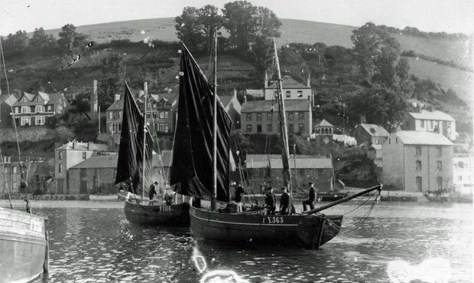
Guiding Star was built in Looe, Cornwall in 1907 as fishing lugger FY363 for for Thomas Soady and his three sons by shipwright James Angear. For thirty years, she fished for mackerel, pilchards and herring off the coast of Cornwall.
A mile or more of nets would be let down over the starboard bow, and with just the mizzen sail up, the boat would hold its nose into the wind and drift gently astern. Hauling in the nets full of fish was backbreaking, dangerous work, and life on board was cramped and uncomfortable. Most of the hull was taken up by the fish and net holds, and five or six men would have bunked in a small cabin either in the bows or the stern.
Guiding Star was one of the last Looe boats to be designed as a pure sailing boat, so she has a finer hull and sails faster than boats built only three or four years later after petrol engines came in. Her hull speed, the maximum speed she can theoretically move through the water, is just under 8-1/4 knots, and she’ll touch 8 knots in a good breeze.
Fishing always has busts as well as booms, though, and Looe suffered in 1935 after the League of Nations imposed sanctions on Italy for its invasion of Abyssinia. Exports of dried pilchards, which Looe used to send to Italy as food for people making pilgrimages, were banned and fishing families suffered greatly. So it’s no surprise that in 1936, Thomas Soady’s son Jim sold Guiding Star out of fishing. She was converted into a yacht at Uphams yard in Brixham and re-registered in 1937 as Outward Bound, owned by a surgeon in Paignton.

Guiding Star soon returned to her original name and passed through several hands in the 1940s and 50s. Julia Olsen remembers sailing on her with her father at the end of that period as a girl aged nine: “I learnt to climb the ratlines, splice, whip and read the Walker log on journeys along the south coast, Brittany and Channel Islands. And even sail by myself on the tender – a “duckling” I believe, with lug sail – set loose in Weymouth harbour.”


From 1960-1989 Guiding Star was owned by Brigadier Jack Glennie and his wife Marguerite, who sailed her all around Europe. His son Colin remembers the family going from Belfast to Dublin one Christmas to watch a pantomime, and his parents finding Guiding Star in Dun Loaghaire harbour south of the city. They bought her on the spot and left their two teenage boys to look after her for the rest of their school Christmas holiday became Jack had to go back to work.
Colin said his mother was the original sailor in the family. She grew up in Egypt where her father had worked for the Suez Canal Company and had a dinghy on the Great Bitter Lake. When Jack met Marguerite during World War Two while serving in Egypt, he thought he’d better learn to sail!
Colin said he and his brother later lived on board with their parents at Cubitt Wharf on the Thames when Jack commanded a Territorial Army brigade in London. Barry Jobson, who bought the boat in 1989, said Jack told him that the spray hood, which you can see in the photo above in St Katharine’s dock, came from a motor torpedo boat. It looks odd on a Cornish fishing boat but it gives the helm at some protection from wind and the rain, which you need because there’s no cockpit or autopilot.
Marguerite was famous in later life for smoking a clay pipe on board. Chris Rees, the shipwright who built Spirit of Mystery and Grayhound, says as a child he used to row round Guiding Star on her berth in Millbrook Creek off Plymouth Sound when the tide was in and he was quite scared of Marguerite.
Guiding Star was in a sorry state when Barry and his wife Jackie Gillespie found her in 1989. They tried to sail her to Bristol to work on her but had to turn back a few miles out because she was taking on more water than they could bail. Barry and Jackie spent three years rebuilding the boat and then sailed her to the Caribbean and back. Classic Boat featured the full story of this in March and April 1997.
Barry thought she could do with more speed, and when they came back from the Caribbean he changed her Bermudan mizzen back to a standing lug sail. It’s certainly a powerful sail, worth a knot of speed in winds up to Force 5, when the weather helm becomes too much to resist.


Paul and Sue Eedle bought Guiding Star in 2016. Sue doesn’t sail but Paul cruised Guiding Star in southwest England and Brittany, taking her to many traditional boat festivals.

James Angear, who designed and built Guiding Star, was born in 1849, the middle of nine children including two elder brothers who were carpenters and one who was also a boatbuilder. James would have been in his late 50s when he was building Guiding Star, so most likely at the peak of his skills.
His great grandson, Brian Isbell, kindly sent information on the family history and this photo of James in comfortable middle age with his wife, LizAnn Little, and their dog. Both the Angears and the Littles were large Looe families.

This lovely boat might be Guiding Star, but isn’t. Frank Raine sent this photo and the boat is another lugger built by James Angear, Welcome, which his family owned in Brixham from 1940 to 1952. She looks extremely similar to Guiding Star in hull shape.
Sadly, I haven’t been able to find any information on what happened to her. If anyone knows anything about Welcome or about any other boats built by James Angear, please get in touch.
For more information on Guiding Star’s history and importance, please see the draft Statement of Significance assembled for National Historic Ships UK. Guiding Star’s existing entry in the National Register of Historic Vessels is here.

 Guiding Star 1907