Galleries

Desert islands in France

Concarneau’s ‘Ville Close’, its old walled town in the river

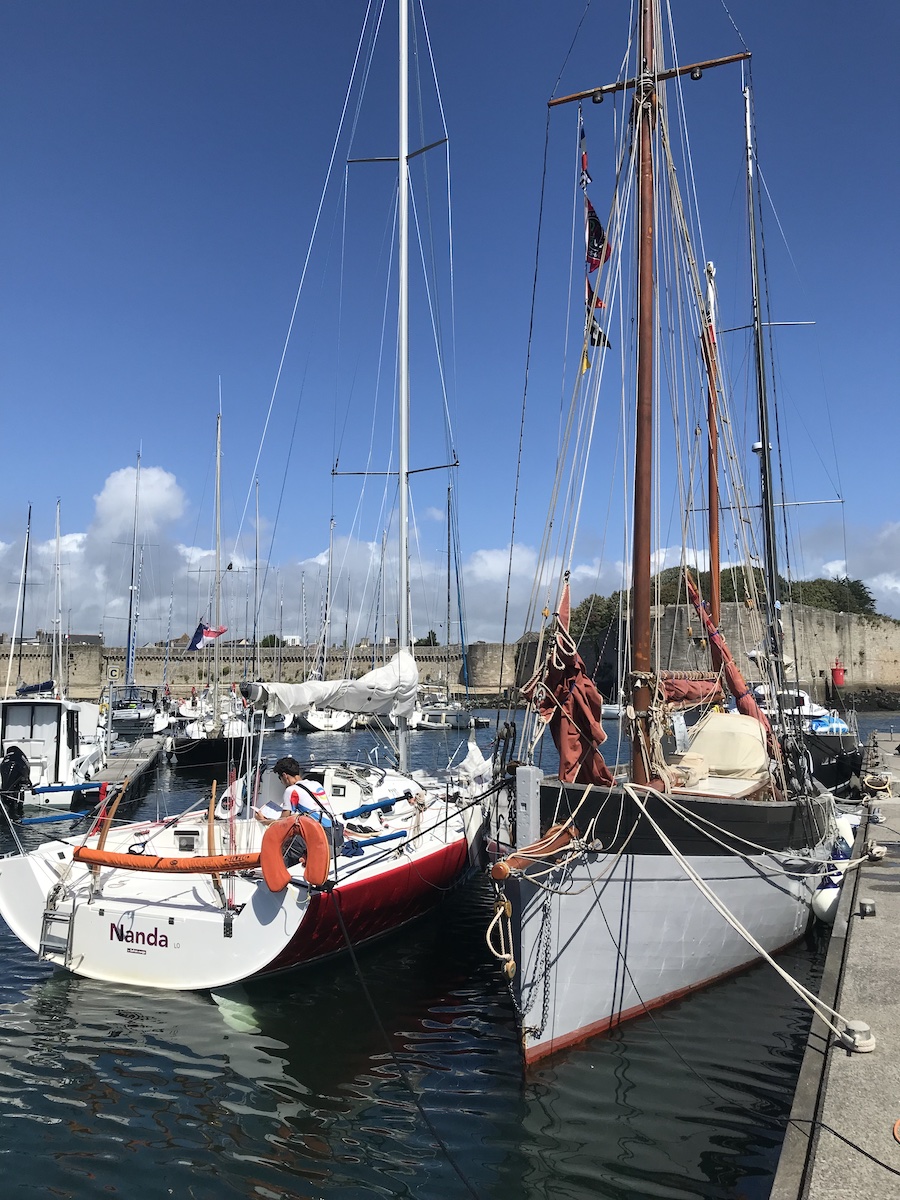
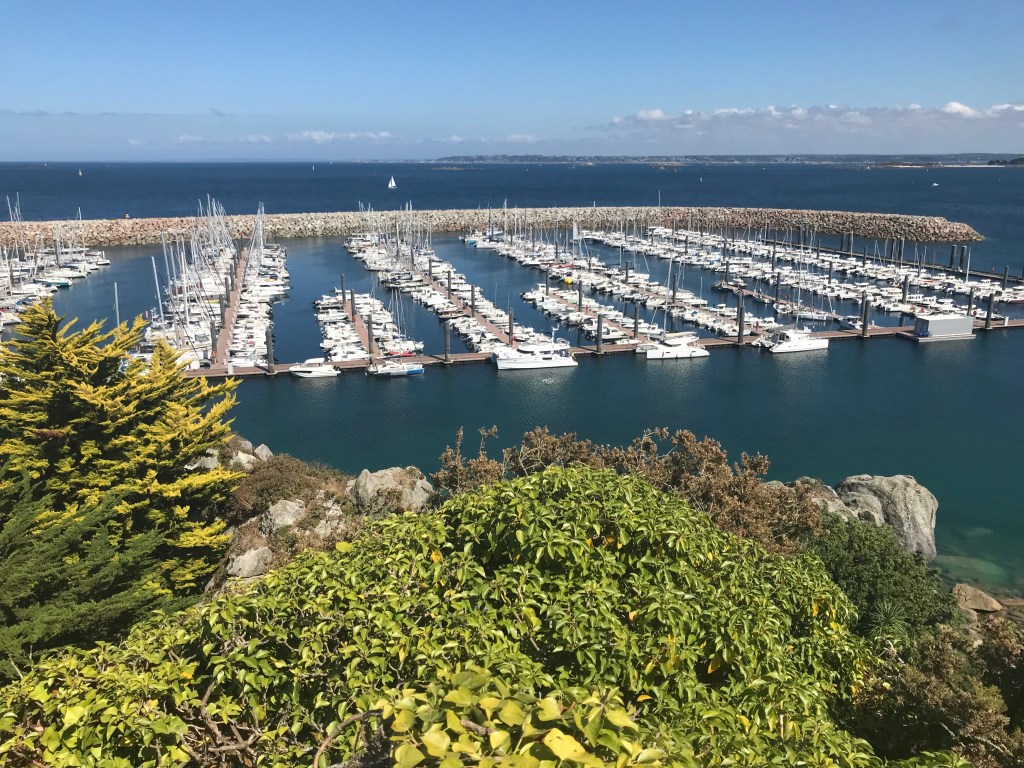
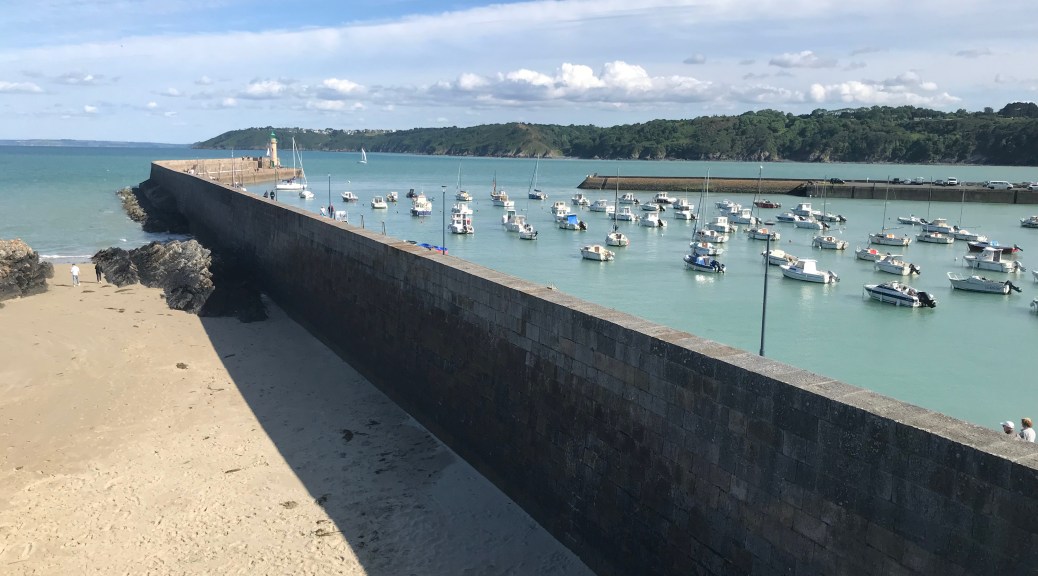
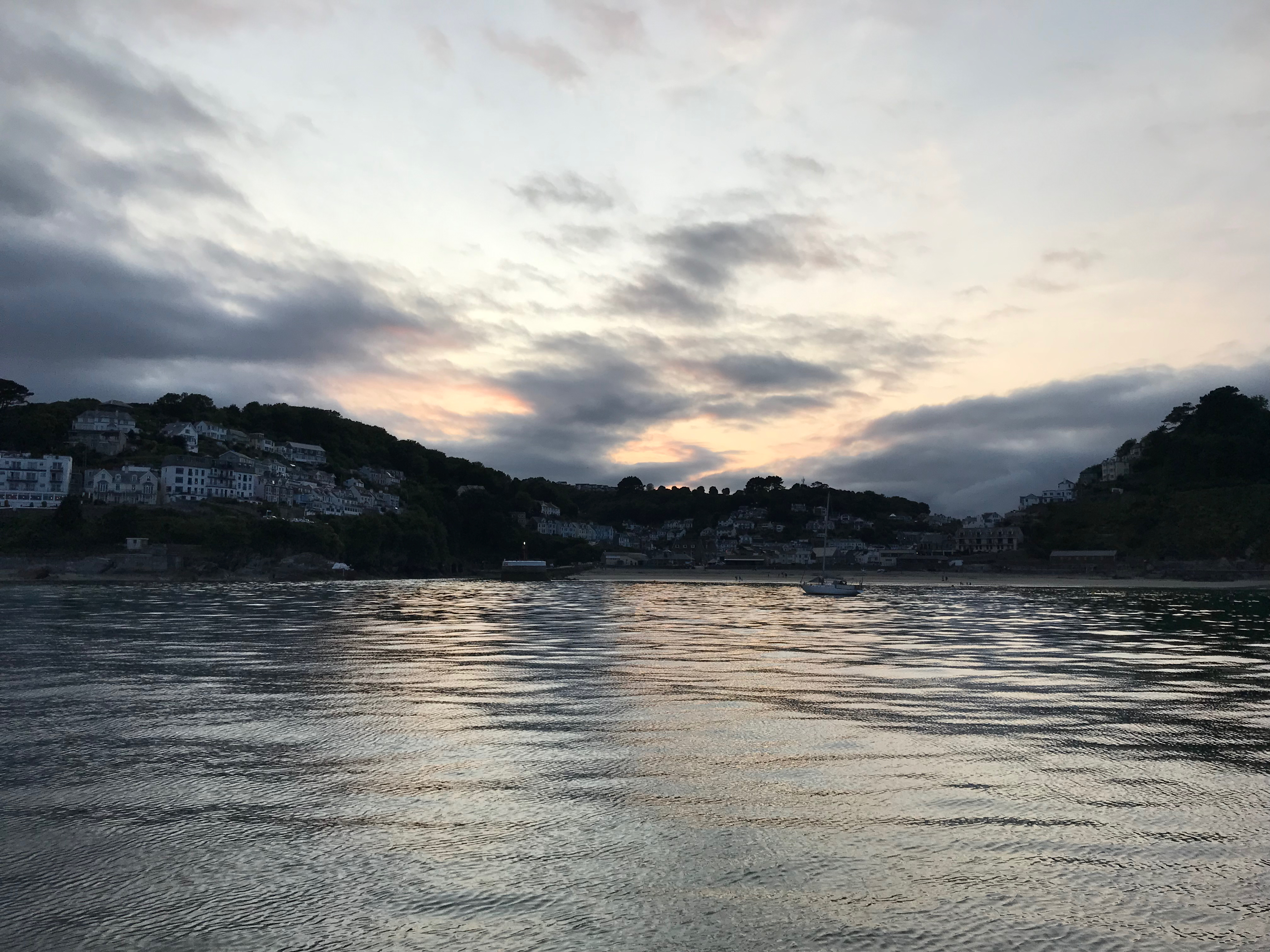
Concarneau is a beautiful place to be stuck for a week without crew. The mediaeval walled town, on an island in the entrance to the river Moros, teems with tourists during the day but empties in the evening and you can stroll round the ramparts in the cool to look down on your boat in the town marina.

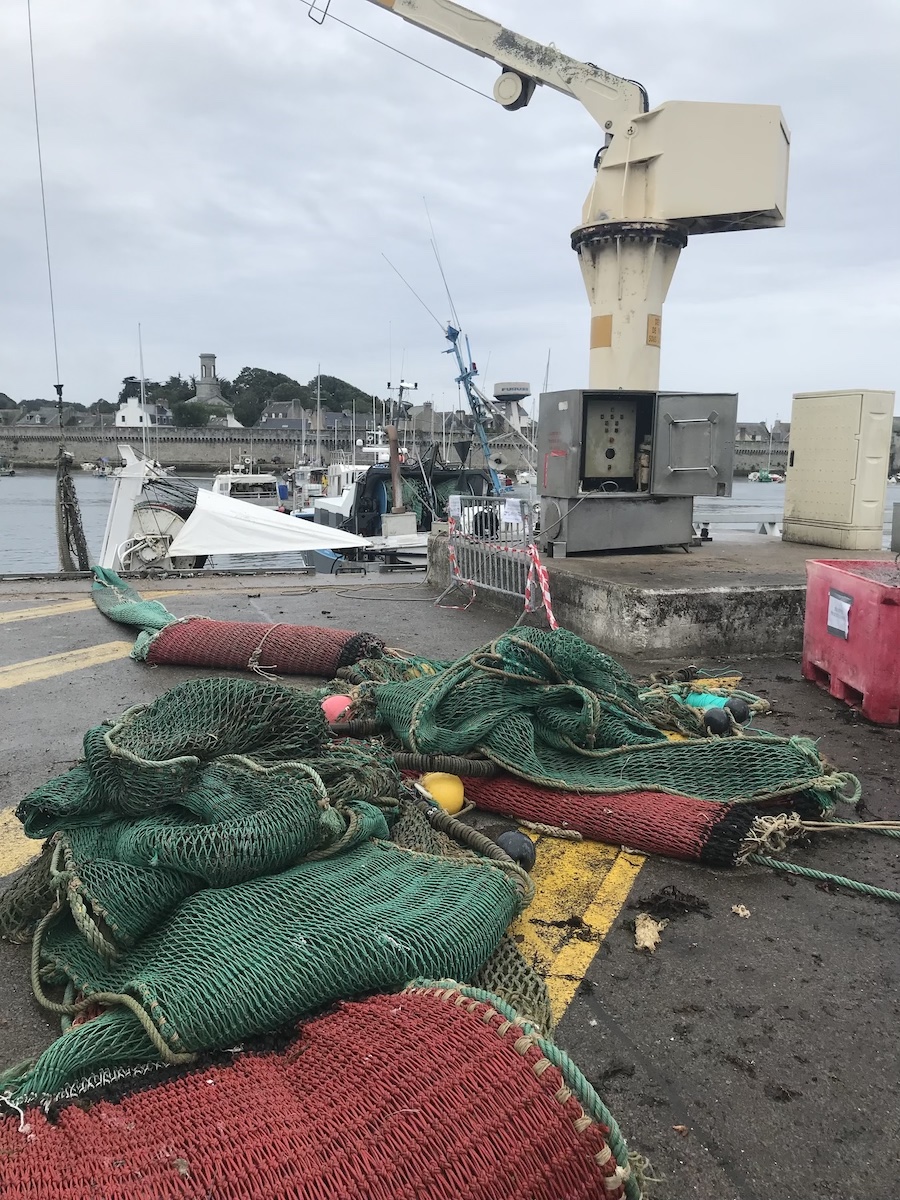
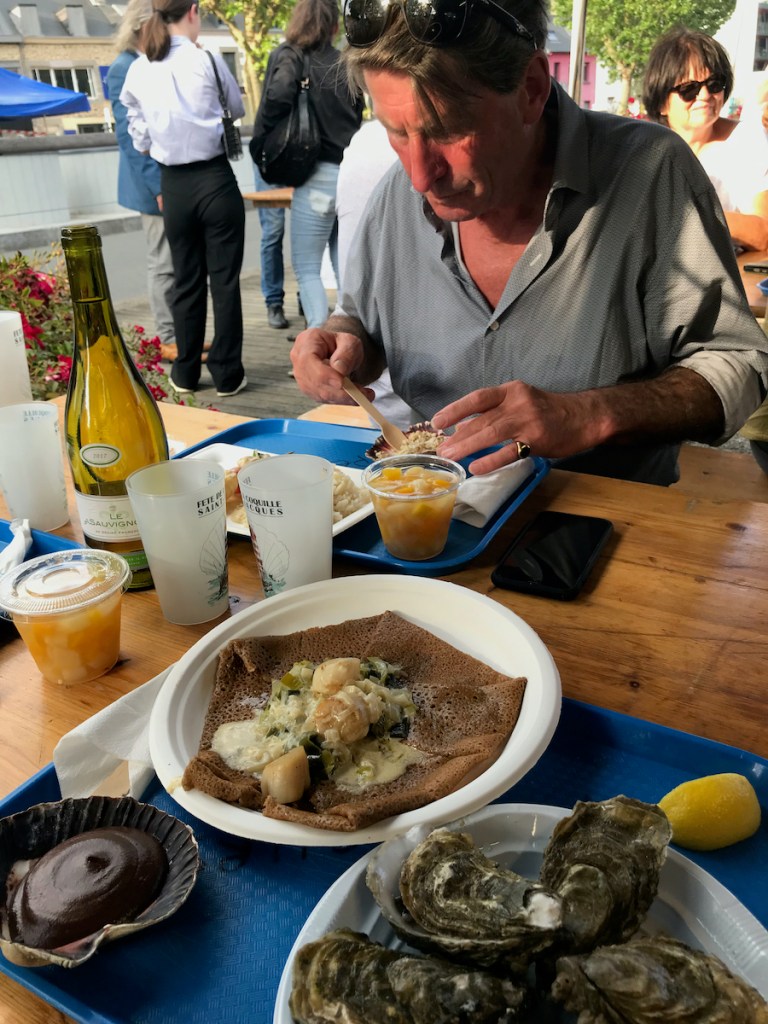
The quays upriver from the walled town form one of the biggest fishing ports in France so the seafood in the market and the restaurants around the harbour is spectacular. The shellfish stall inside the entrance of the market offers half a dozen different types and qualities of oyster, not to mention a bottle of chilled Muscadet for €5.
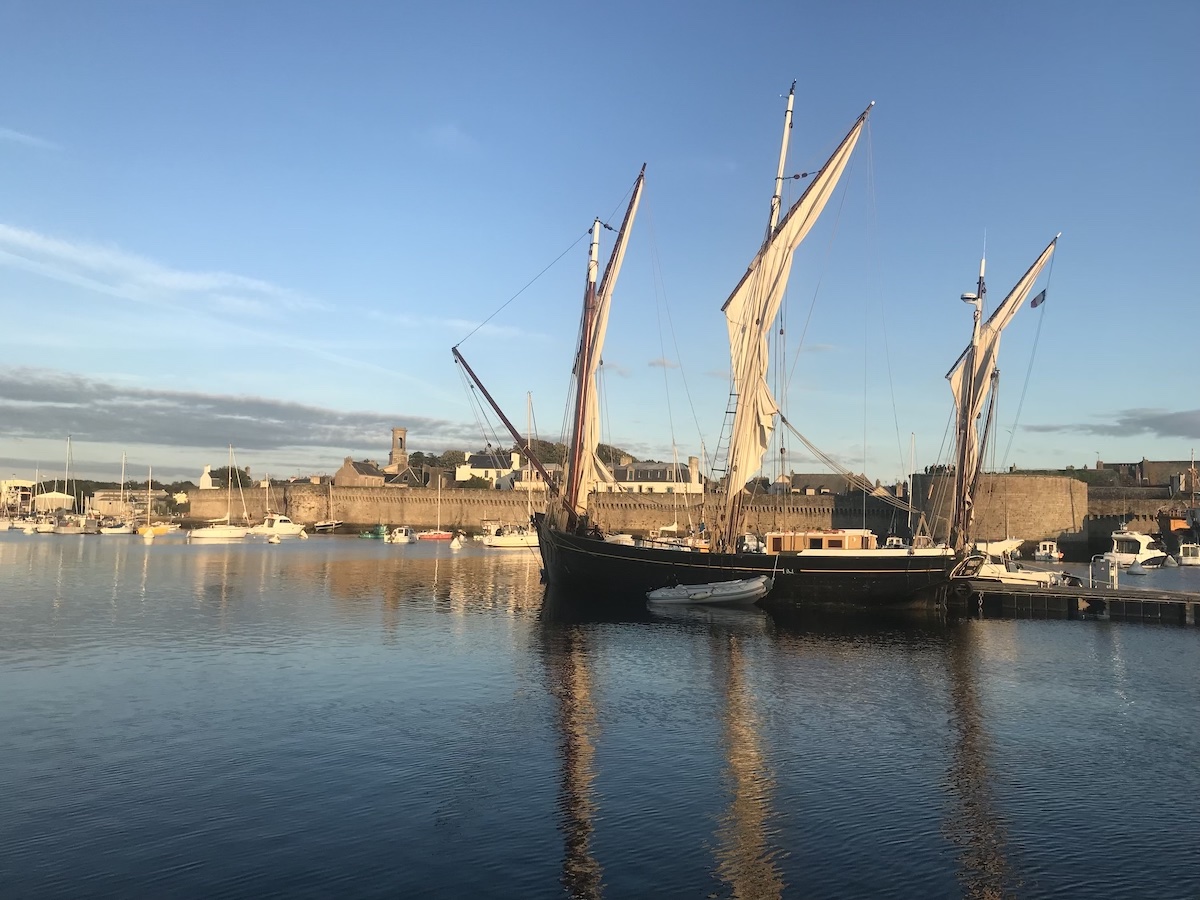
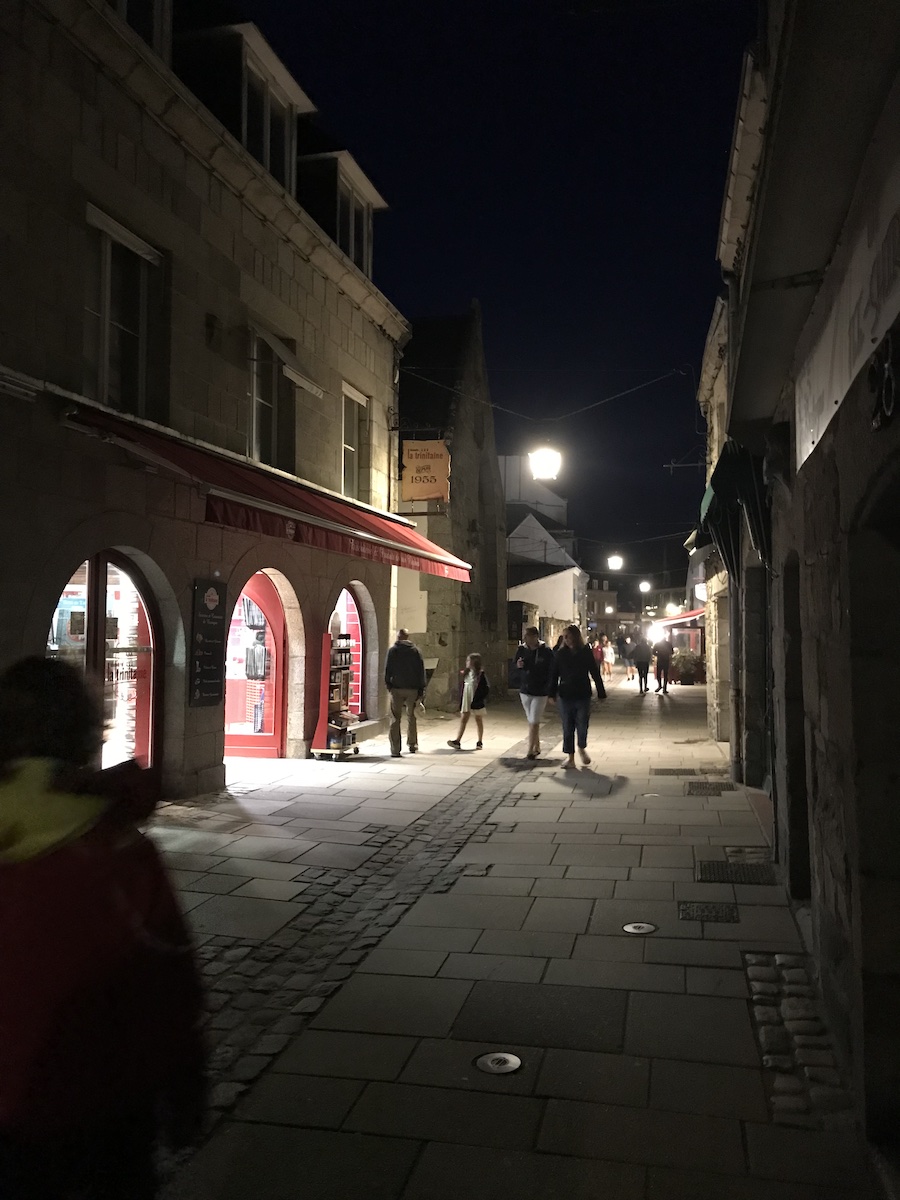
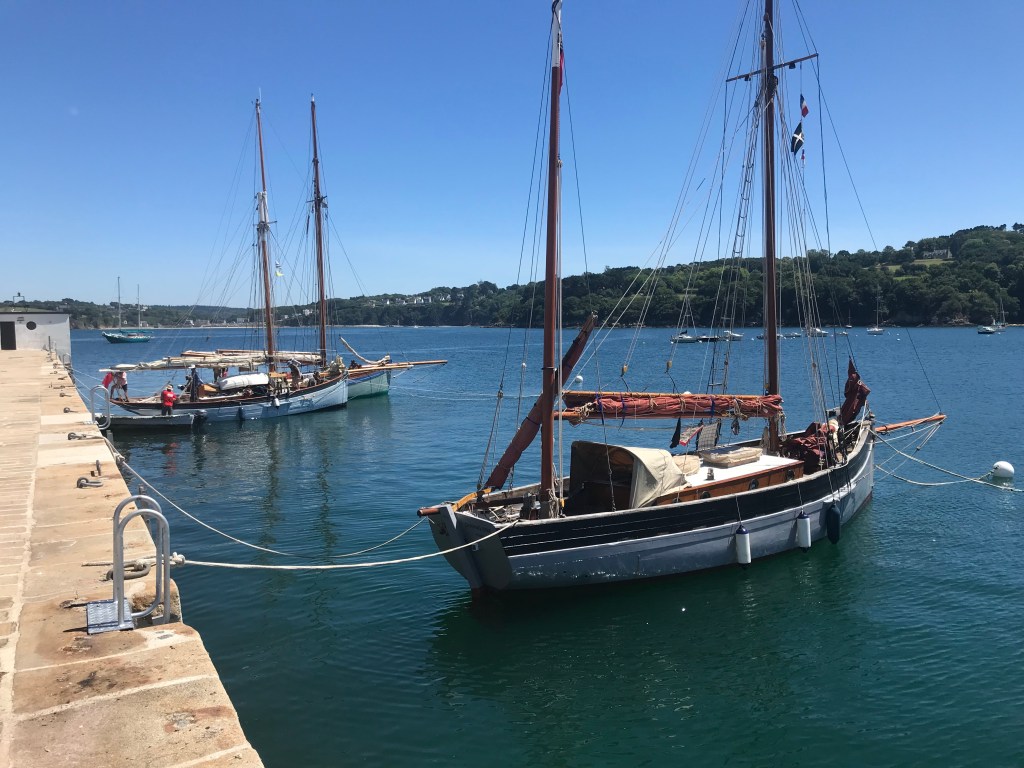
Awkward-sized, poorly manoeuvrable visitors berth on the breakwater pontoon on the outside of the marina under the walls of the Ville Close. My friends Andy and Amina stopped off in their bilge-keeler for coffee at the start of a long haul from the muddy creek where they keep her to Roscoff on the north Brittany coast and Plymouth.
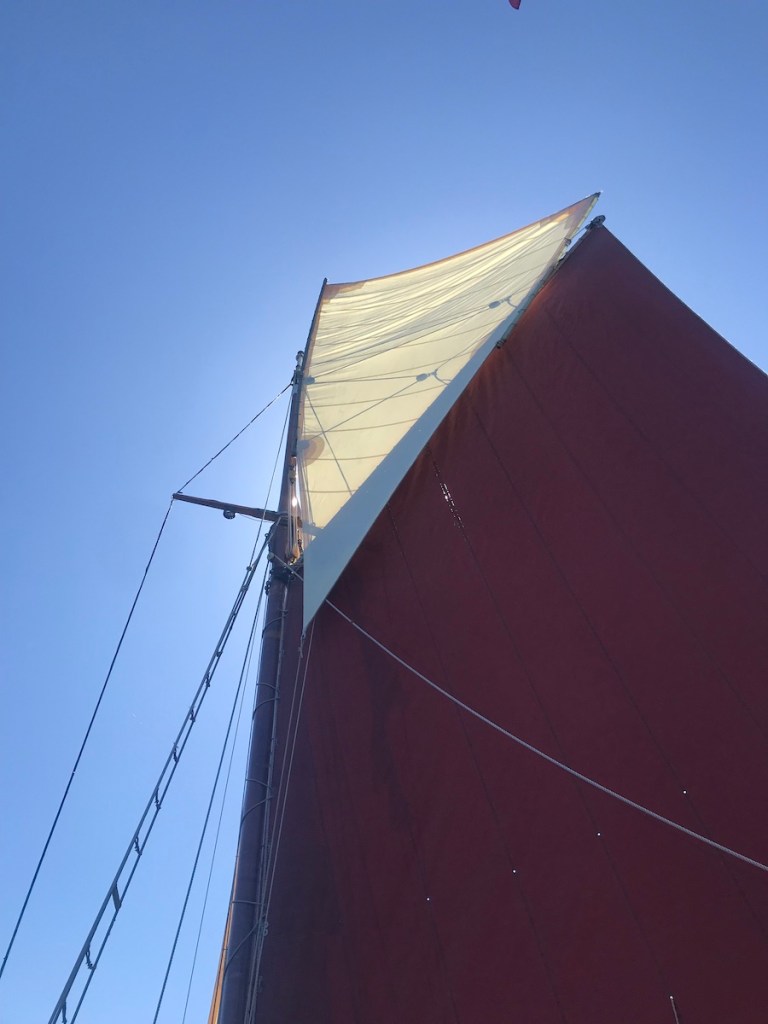
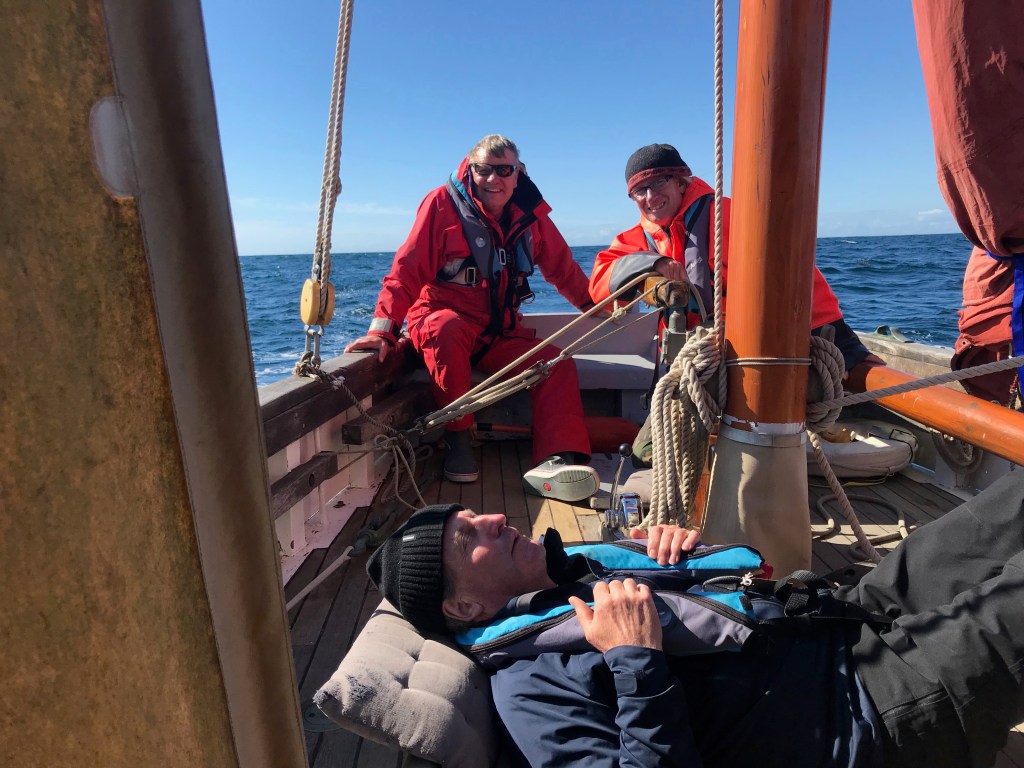
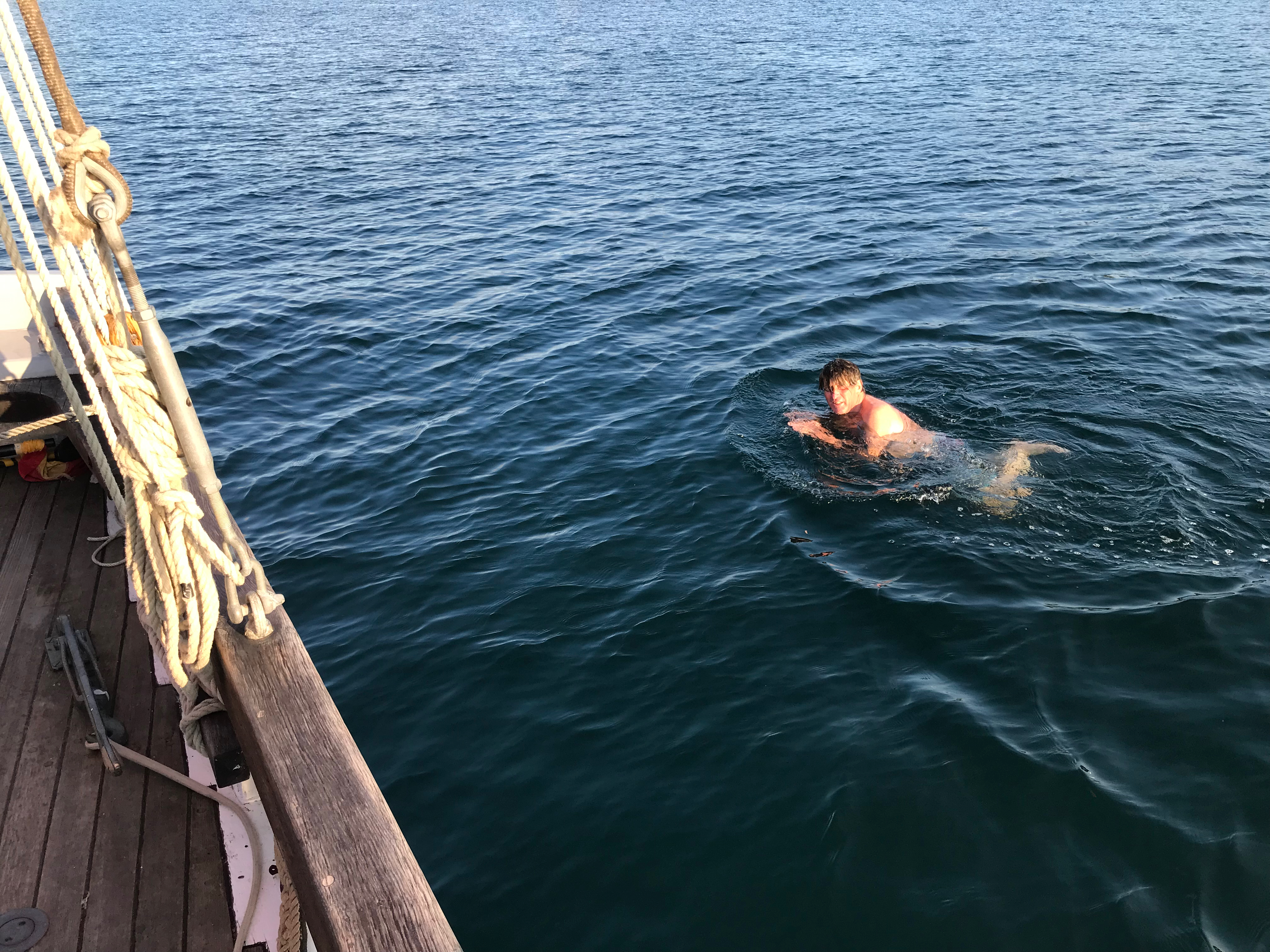
When Chris, John and Lewis arrived a couple of days later, we headed south-east with all sails up and anchored at Port Manec’h, the entrance to the rivers Aven and Bélon, where Lewis jumped straight in before rowing Chris ashore for a beer.
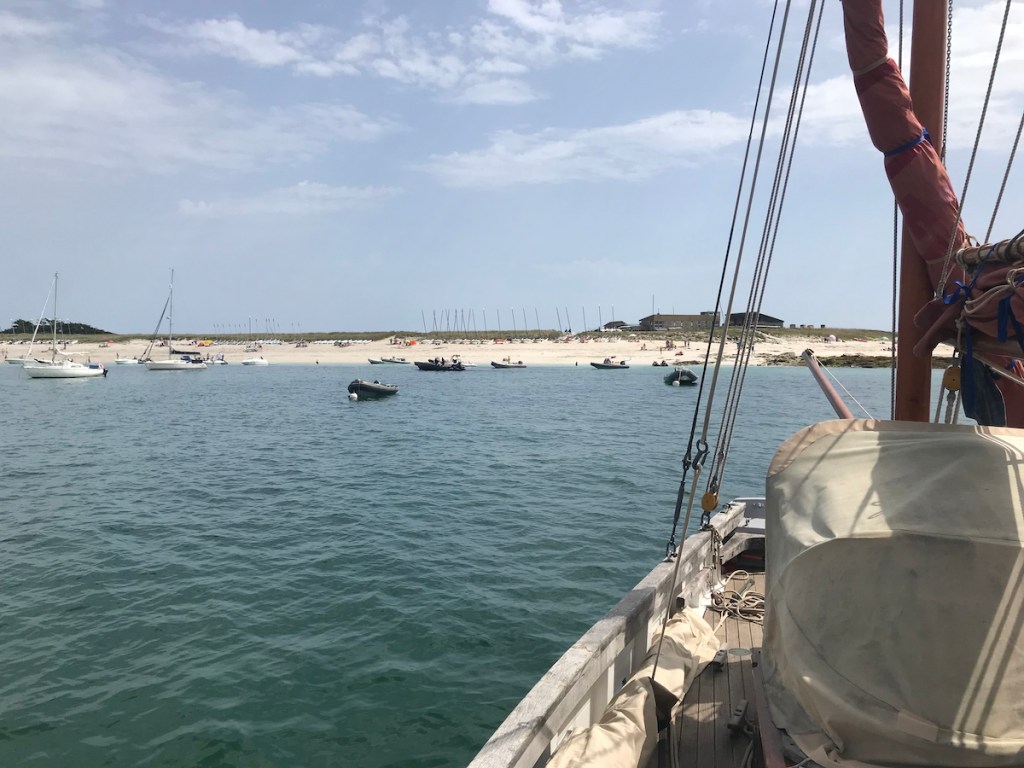
Île de Penfret

Cloudless, hot weather can’t last and thunderstorms were forecast for the evening when we set sail next day for the Îles de Glénan, an archipelago of small, sandy islands which my friend Eric, who’s 93 and spent years sailing the Brittany coast, had been urging me to visit.

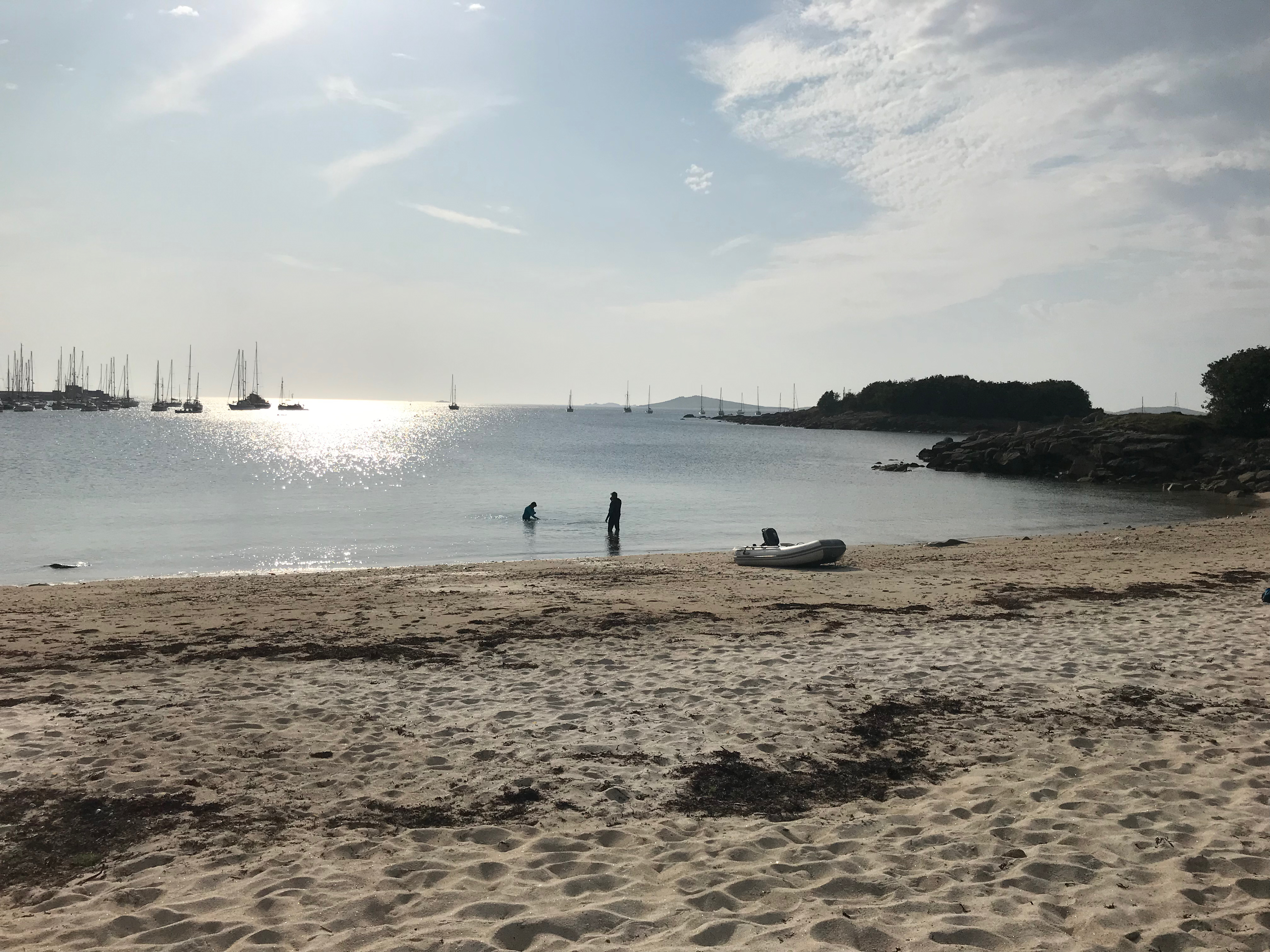
Because of the forecast, we stayed only long enough for a swim ashore and lunch on the boat but he’s right, the islands are magical. The sand is white, the sea is blue and with no other land in sight you feel as if you’re in the middle of the ocean although you’re only five miles offshore.

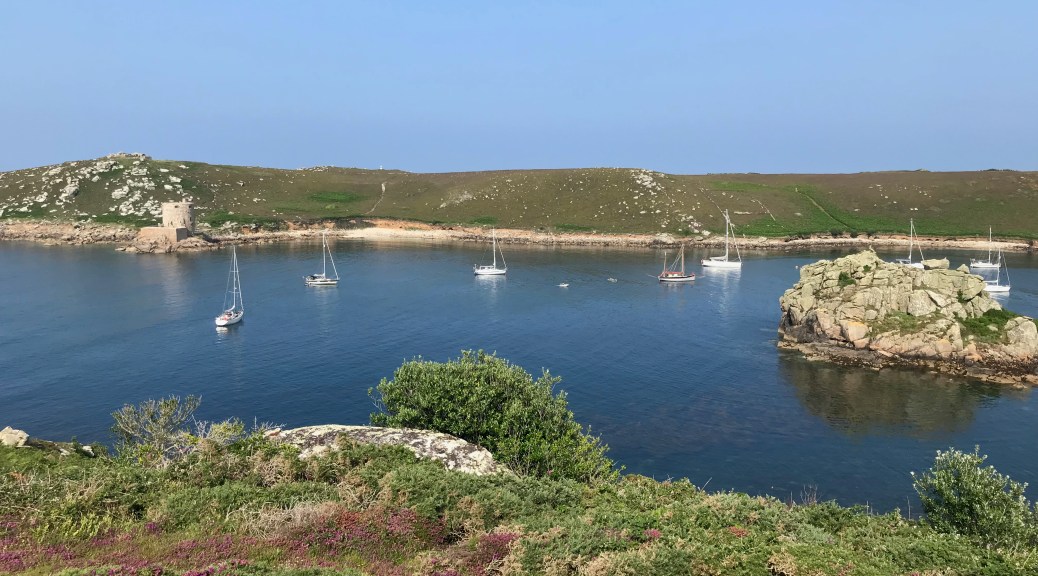
We anchored off the Île de Penfret, which is a sailing holiday camp for teenagers. Looking across the water less than a mile to the gentle hump of the Île de Guirden, dozens of holidaymakers with beach umbrellas were silhouetted against the horizon and looked like shipwreck survivors on a desert island.
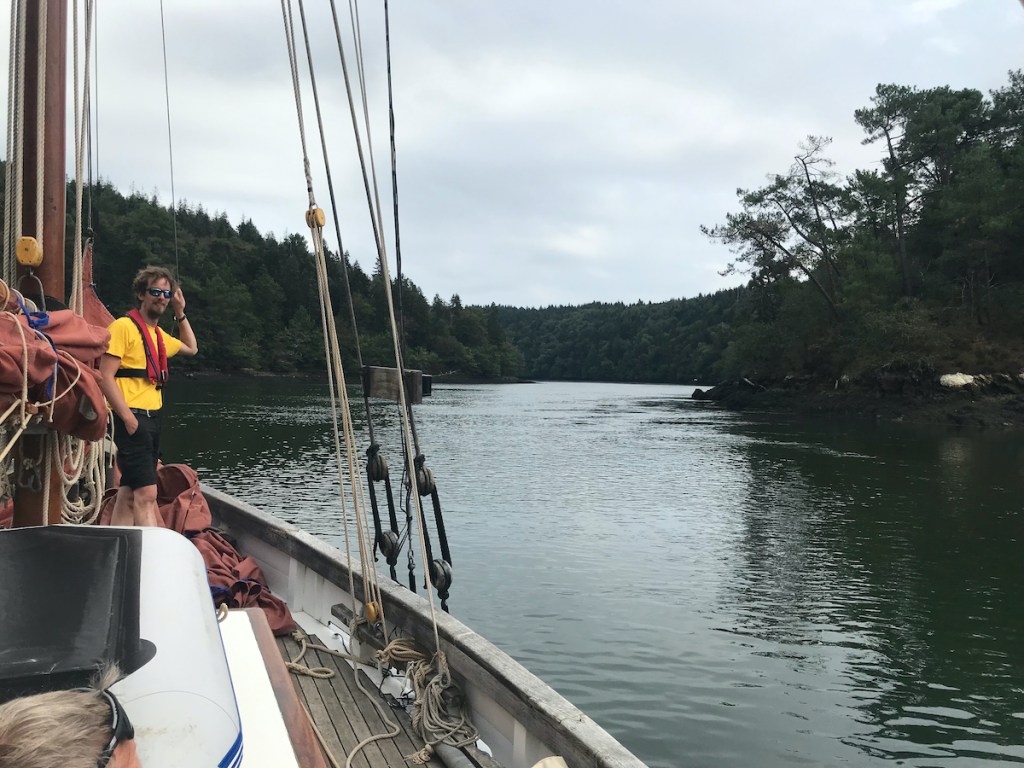
River Odet

We sailed north and sheltered from the thunderstorms in the marina at Benodet, where a fierce tide flooding up the river Odet ran across the visitors’ pontoon and made berthing an adventure. Leaving the next morning was even more difficult but fast work by John, Lewis and Chris kept fenders between the boat and the corner of the pontoon.

Excitement over, we motored quietly upriver between steep, wooded banks. I saw a kingfisher for the first time in my life, a flash of blue. Chris, who saw one first, spotted three. John is a bird encyclopedia and taught us much throughout the trip, including how to identify types of egret by the colour of their feet and how to recognise the call of a tawny owl.
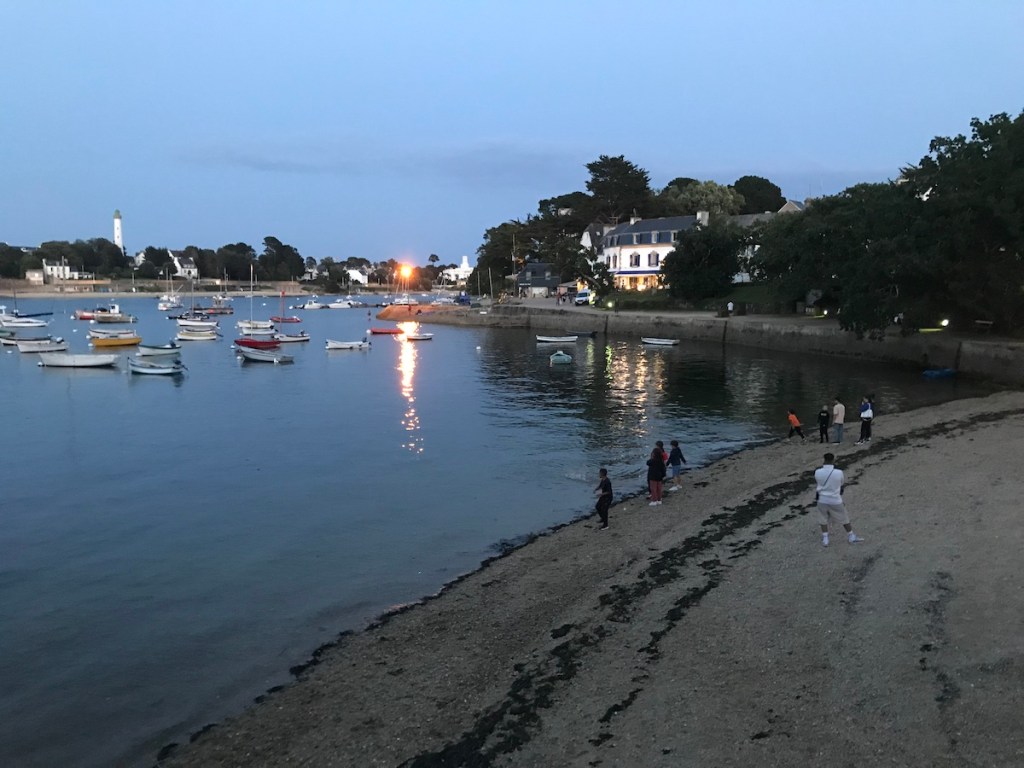
Sainte-Marine, more peaceful than Benodet on the other side of the river

All the anchorages on the chart were full of boats on buoys except for one creek near the entrance to the river where we saw a catamaran under the trees. We nosed in soon after low tide but the bow stuck in mud and it took heroic rowing by Lewis in the dinghy and a rising tide to free us. We retreated downriver to the marina at Sainte-Marine, opposite Benodet, which seemed as peaceful and relaxed as Benodet had been brusque and touristy. The stream even ran straight up and down the pontoon so berthing was much easier.
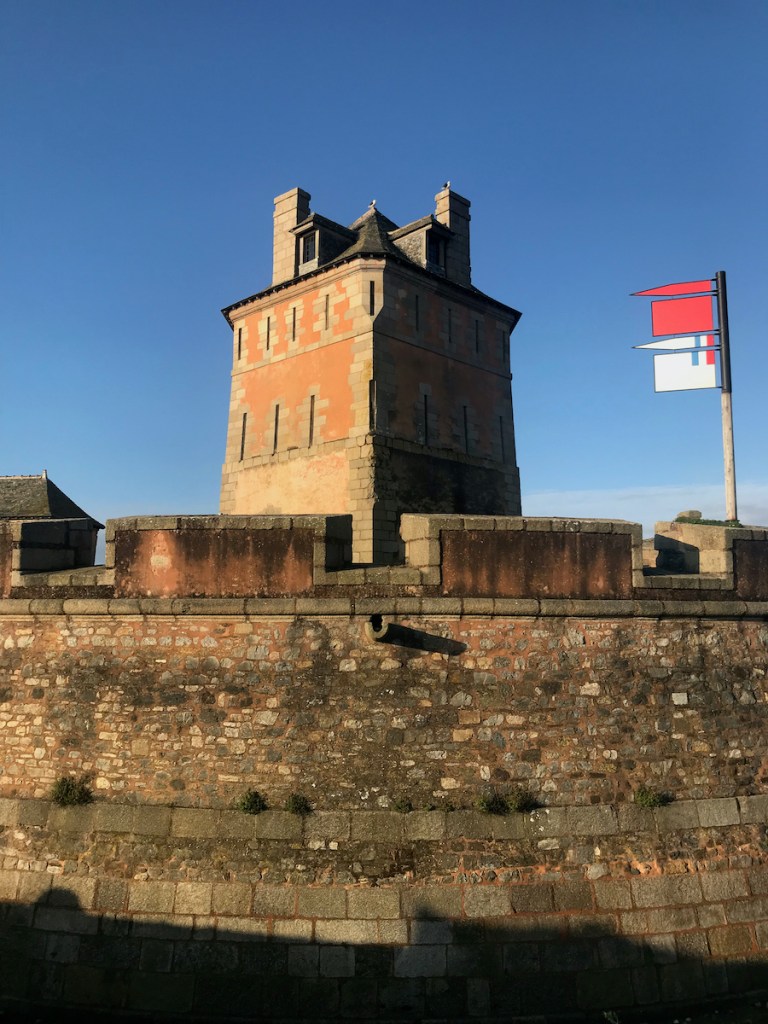
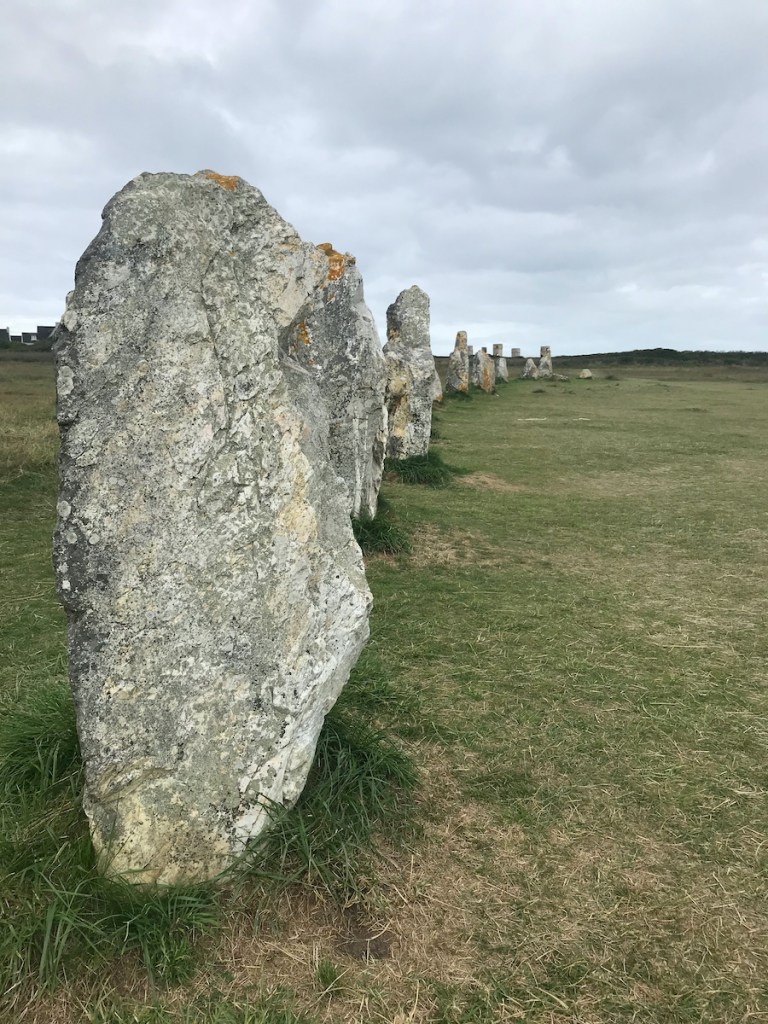
Two days of fine sailing brought us west and north to Camaret-sur-Mer on the south side of the approach to Brest in time for a birthday dinner for Lewis.

Camaret is famous for its seventeenth-century ‘Vauban Tower’, built by Cardinal Richelieu’s leading military architect Sébastien Le Prestre de Vauban as a central link in a chain of fortifications guarding France’s naval base in Brest. It has a gun battery at its base and provided an observation platform covering the whole of Camaret Bay, which was the anchorage where ships waited for favourable wind and tide to pass through the Goulet de Brest to the port.

Before the Tower was even finished, it helped to defeat an Anglo-Dutch fleet which tried to capture Camaret in the Nine Years War, when William III led a Protestant coalition against Catholic France.

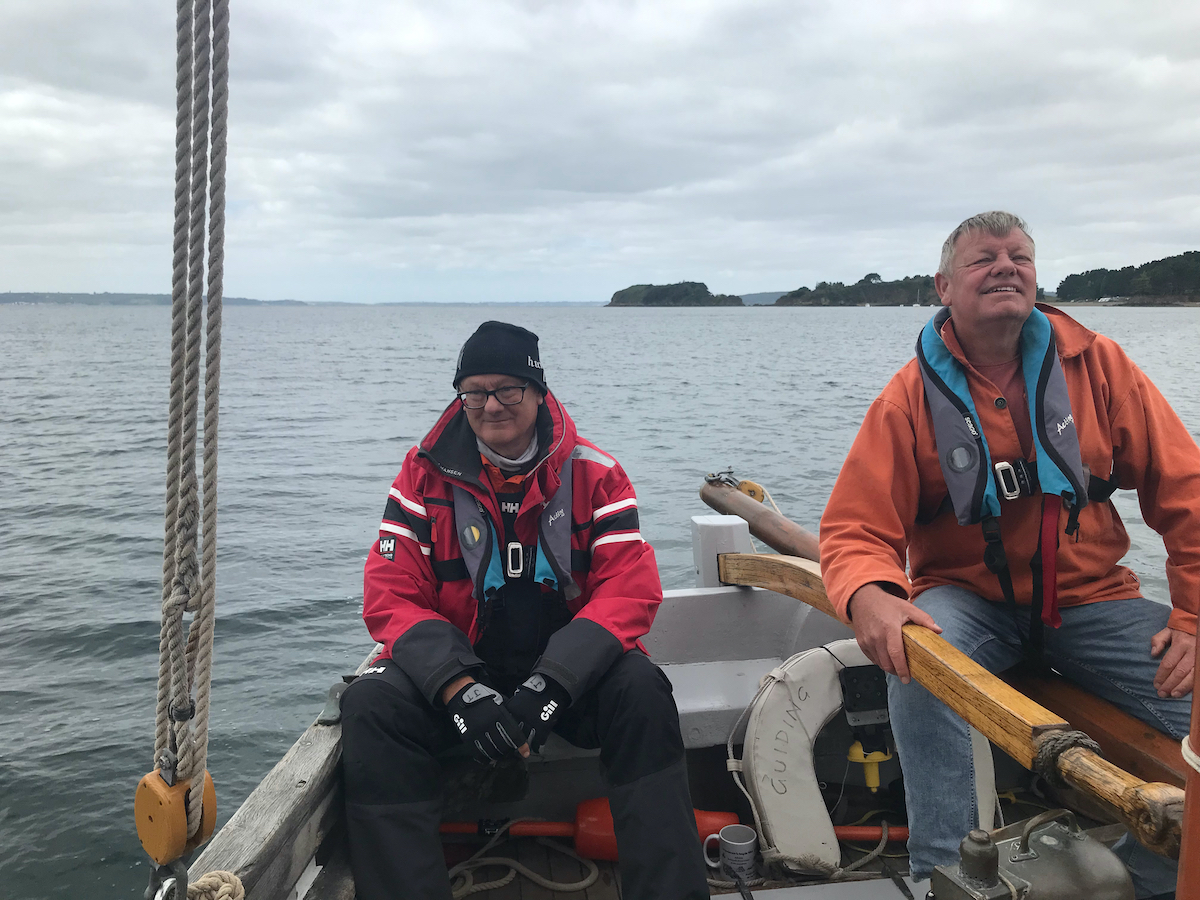
From Camaret, we beat through the Goulet de Brest with the tide under us and reached gently across the Rade de Brest to the river Aulne, which is where the French navy mothballs unwanted warships. We anchored on a peaceful stretch of the river within sight of what looked like the bar at the end of the world, an isolated wooden cabin just above the high water line. Lewis rowed ashore but sadly it was closed.

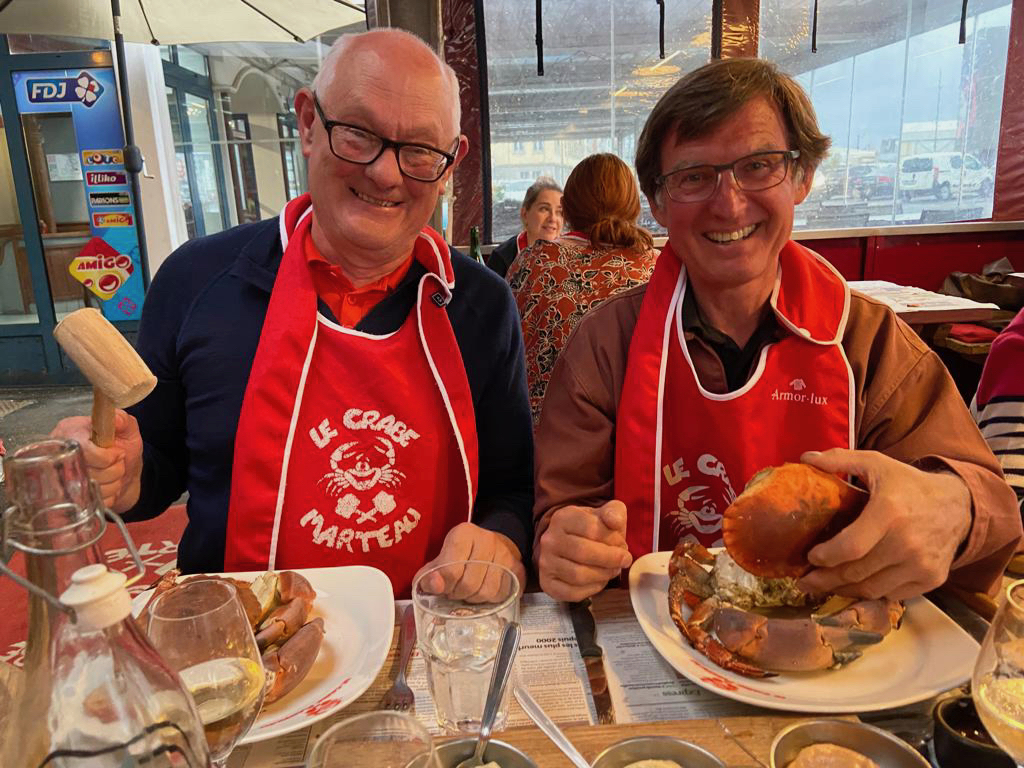
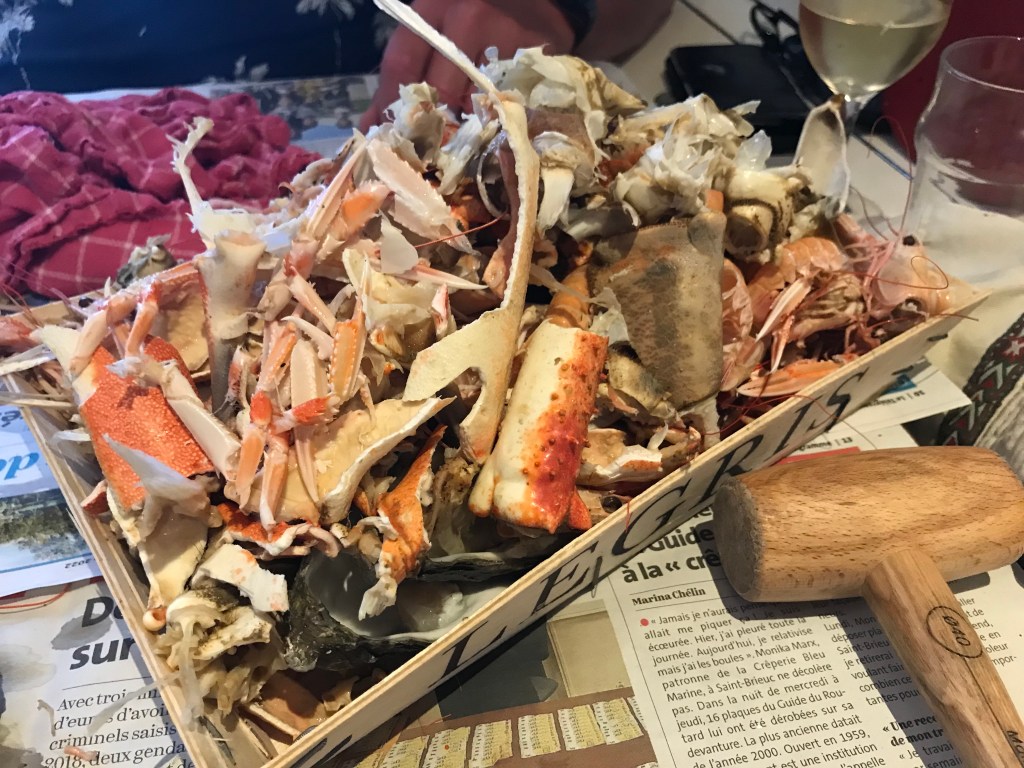
In Brest, we headed straight for the Crabe Marteau, the ‘Crab and Hammer’ restaurant where dinner consists of a crab served with a wooden mallet and a bucket of potatoes.

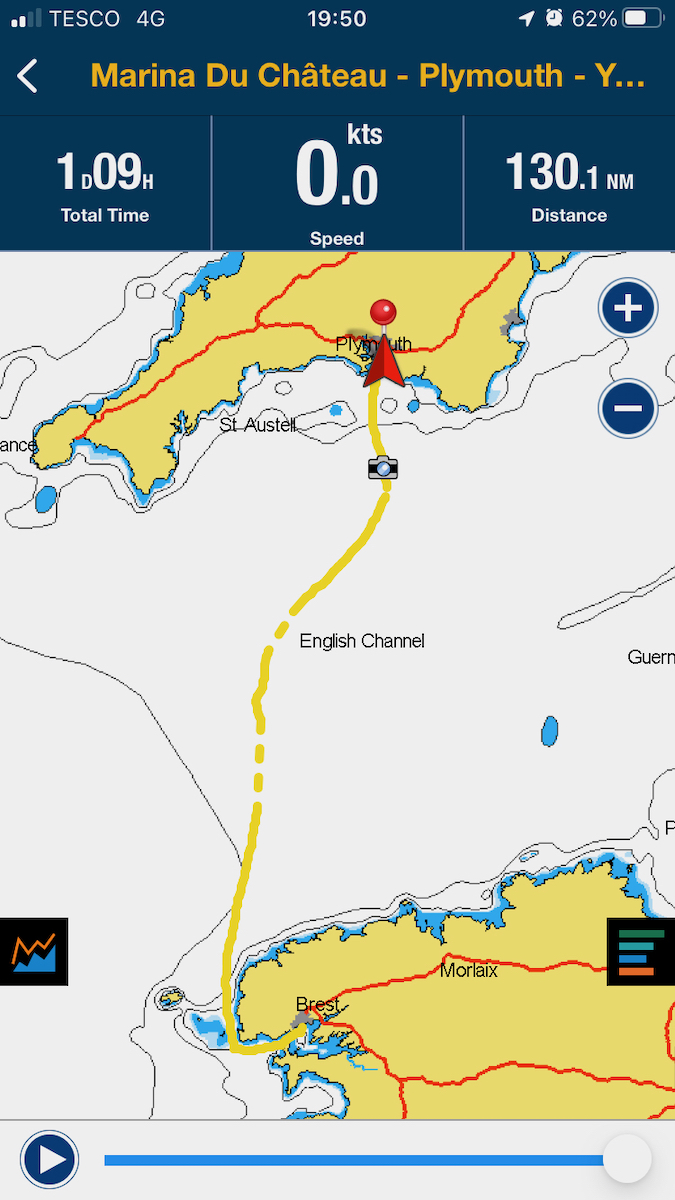
In Brest, I was acutely conscious, as the last time I was here, of the second world war. The modern city is built on the rubble of the old one which was bombed and shelled incessantly by the Allies when it was occupied by the Nazi Germans.

John, Chris and I visited the moving Sadi Carnot Shelter, a 400-metre tunnel from the port to the centre of the city in which civilians sheltered from Allied bombing but German soldiers also stored ammunition. On the night of September 9th, 1943, an accidental explosion and fire killed at least 375 civilians and several hundred German soldiers.

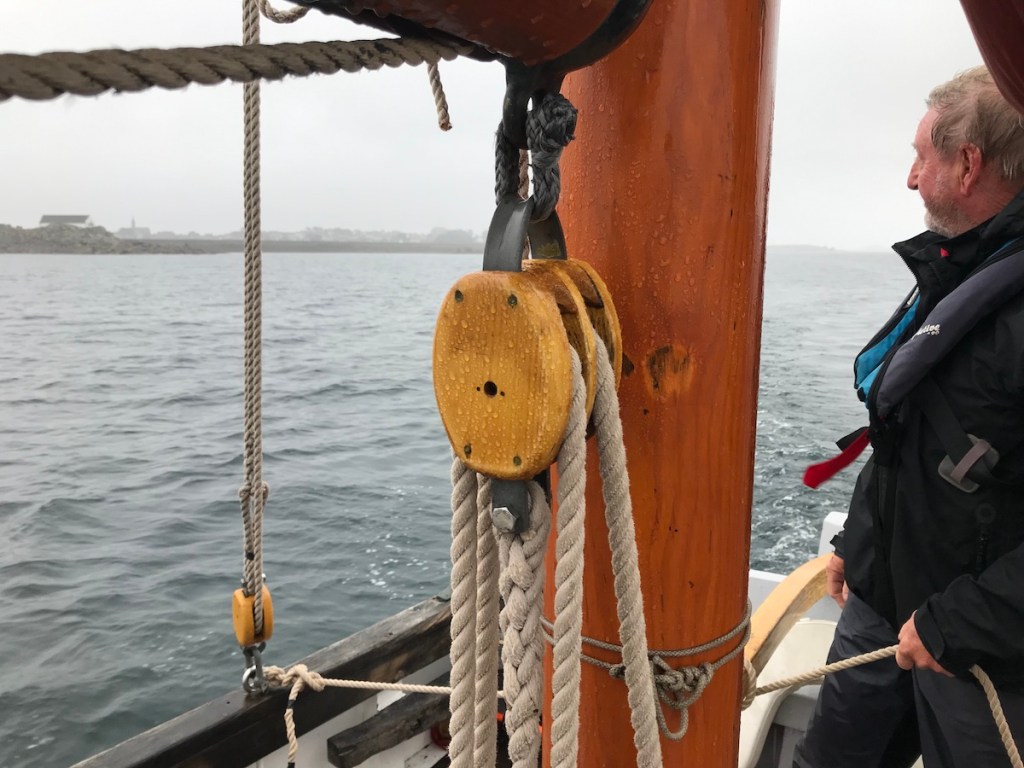
From Brest, we set out for Plymouth on a wet and misty morning and had the excitement of being ordered out of the way by Traffic Control to let a French nuclear submarine escorted by three gunboats pass through the Goulet de Brest.

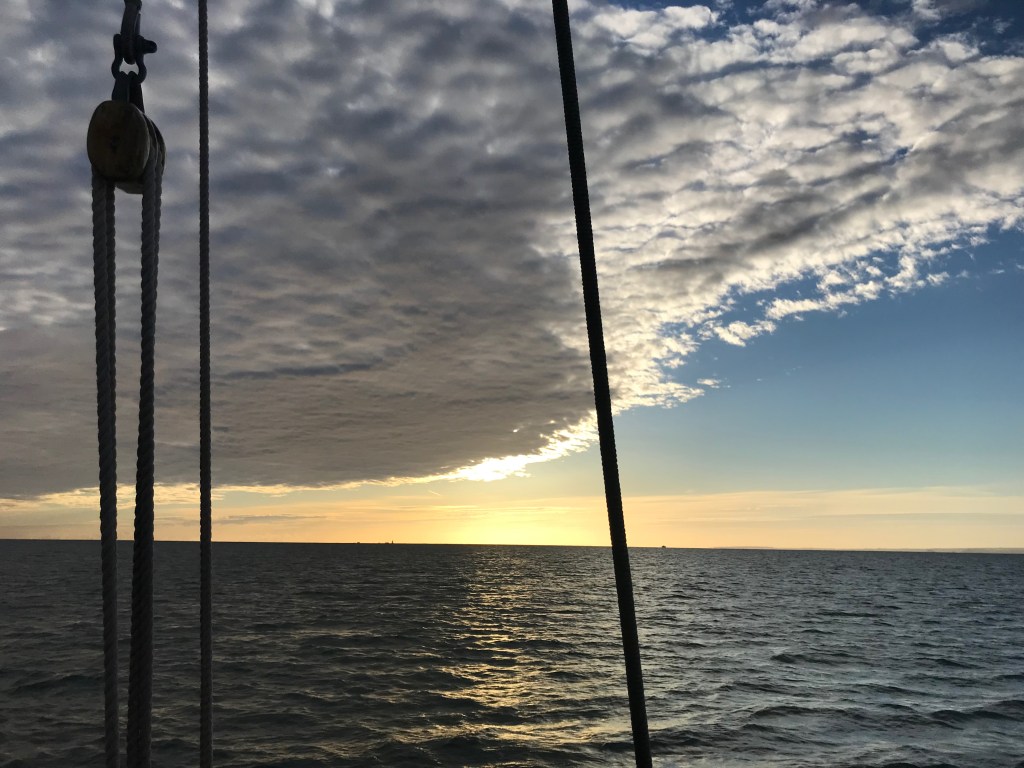
A forecast Force 6 had already passed up the Channel but Chris and Lewis did endure one watch of torrential rain in the afternoon before the sun set in a mass of pink clouds. The southwesterly was blowing from too directly behind us to head directly for Plymouth for the first twelve hours but luckily it veered overnight and we made landfall on a warm, sunny day without having to tack, the perfect end to a summer in France.

Climate Crisis Cruising

This was the year when even people in rich western countries couldn’t avoid the climate crisis: the hottest summer in human history caused havoc across the northern hemisphere, from heatwaves and wildfires to floods. Cruising from southern England to southern Brittany in August, we were on the edge of the action but climate breakdown still shaped almost every day we sailed.

Just reaching France at the beginning of August was the first challenge. On the Wednesday we were due to set out from Plymouth, the Met Office forecast for the Channel read, “Severe Gale Force 9 veering westerly and decreasing Force 8 imminent”.

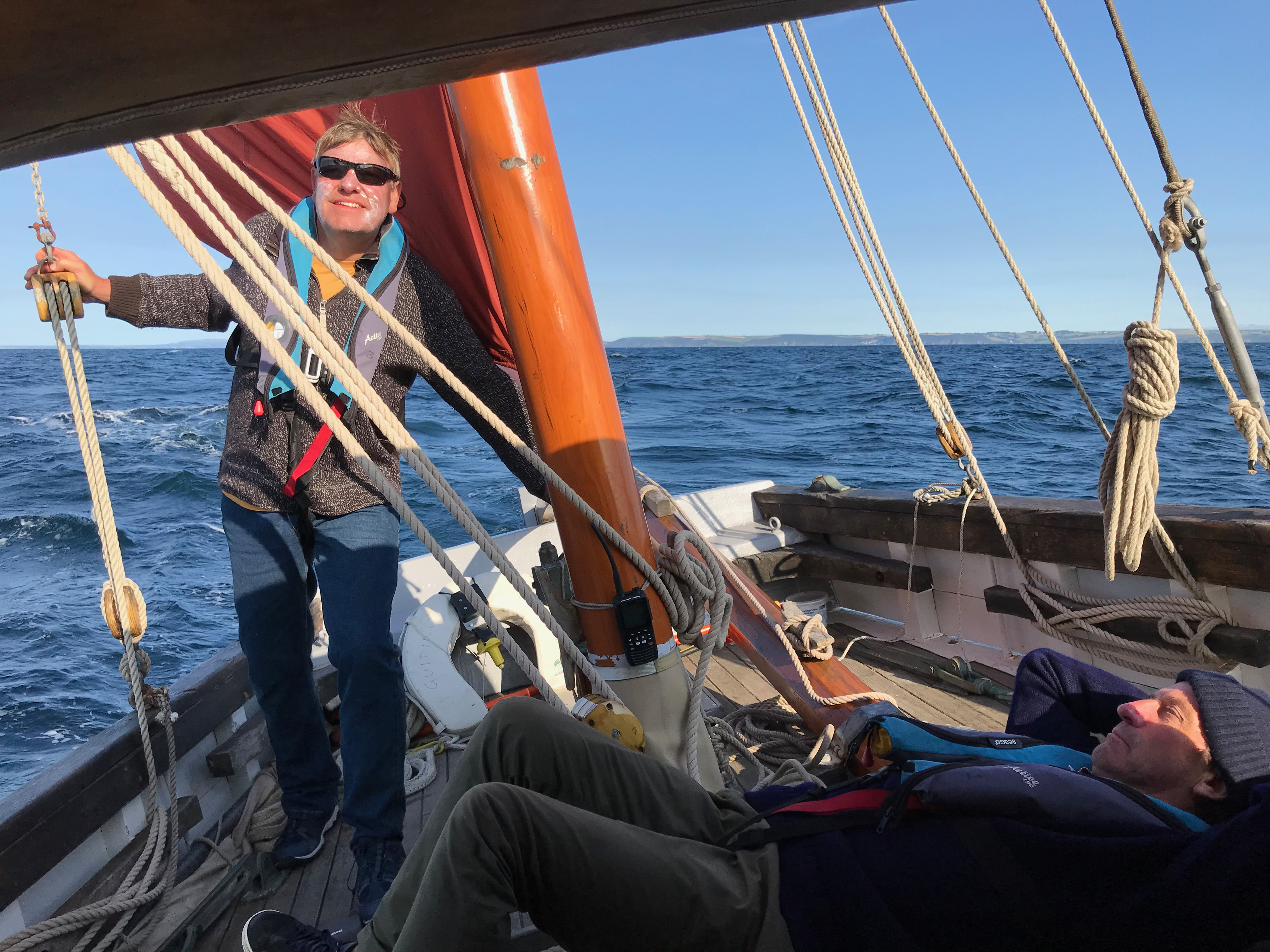
Chris helming in mist and rain

We couldn’t delay too long, not just because we didn’t want to miss the Paimpol festival but because an even bigger storm was forecast for Friday and Saturday: storm Antoni, the first storm of the year fierce enough to be given a name by the UK Met Office. Atlantic storms are supposed to come in autumn, but this was the first week of August. We set off in the early hours of Thursday and had a difficult crossing through the big swell left by the first storm and the strengthening winds of Antoni.

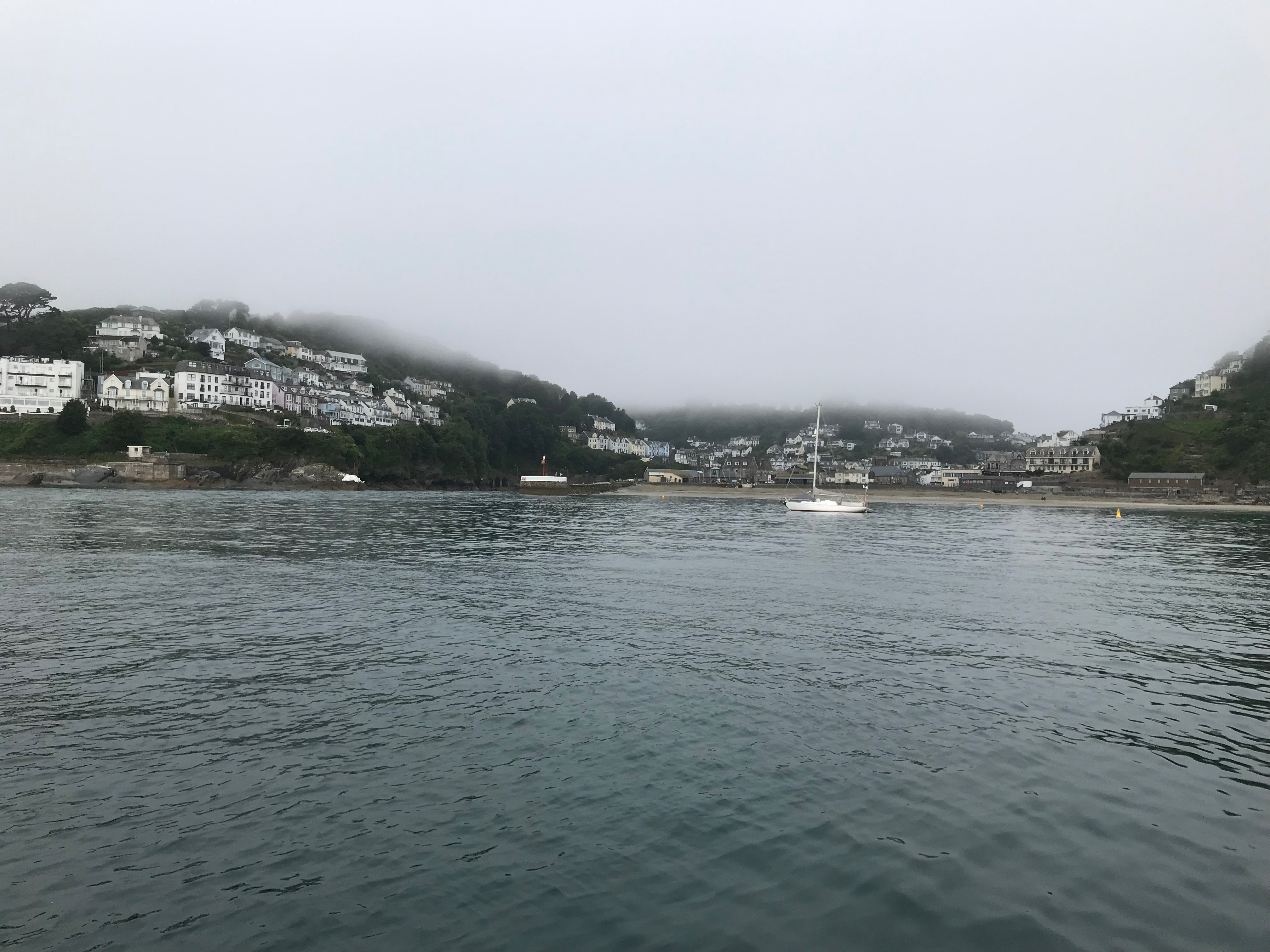
The gale passed north of Brittany but unsettled the weather for more than a week. Heading west along the Brittany coast after a joyous three days at the Paimpol festival, we spent three days bedevilled by fog as warm moist air brought from the Tropics by the storms settled over the cooler sea.

Frederic on a wet deck

Fortunately, the cloud lifted in the evening on the second day as we groped our way through the rocks off Roscoff so we could see to enter the marina. At least there had been enough wind for us to sail most of the way through the murk.

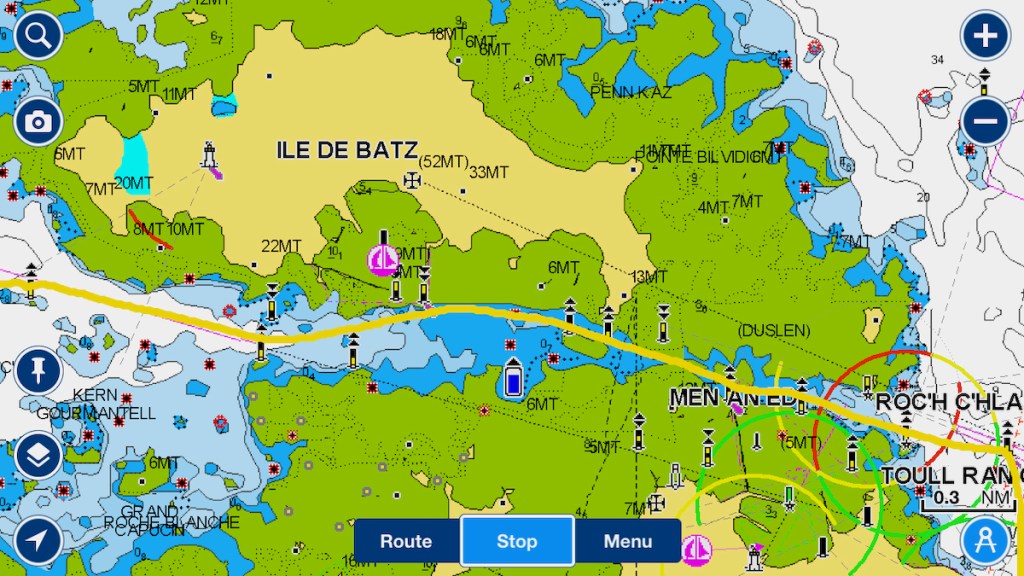
Next morning, the fog thinned enough to let us navigate the narrow channel between Roscoff and the Île de Batz which was an enjoyable challenge.
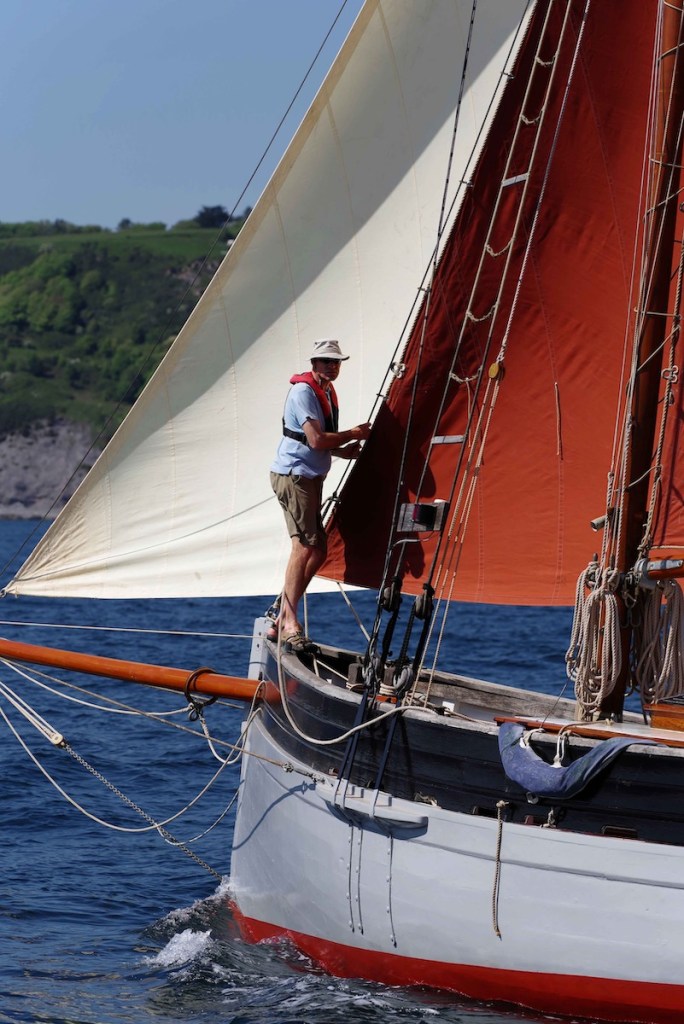
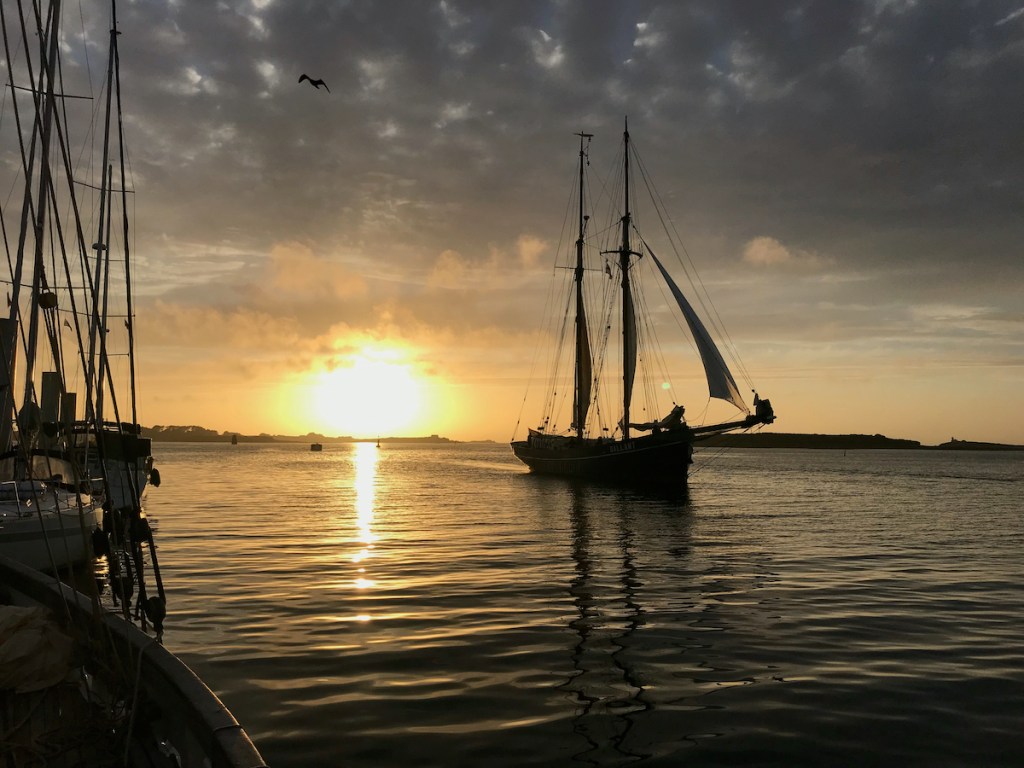
We spent the rest of that day motoring through fog with the wind too light and too directly ahead of us to sail. However, clear sky did open up in the evening after we berthed in L’ AberWrac’h and we watched the sail cargo vessel De Gallant sail into the river against a magnificent golden sunset.
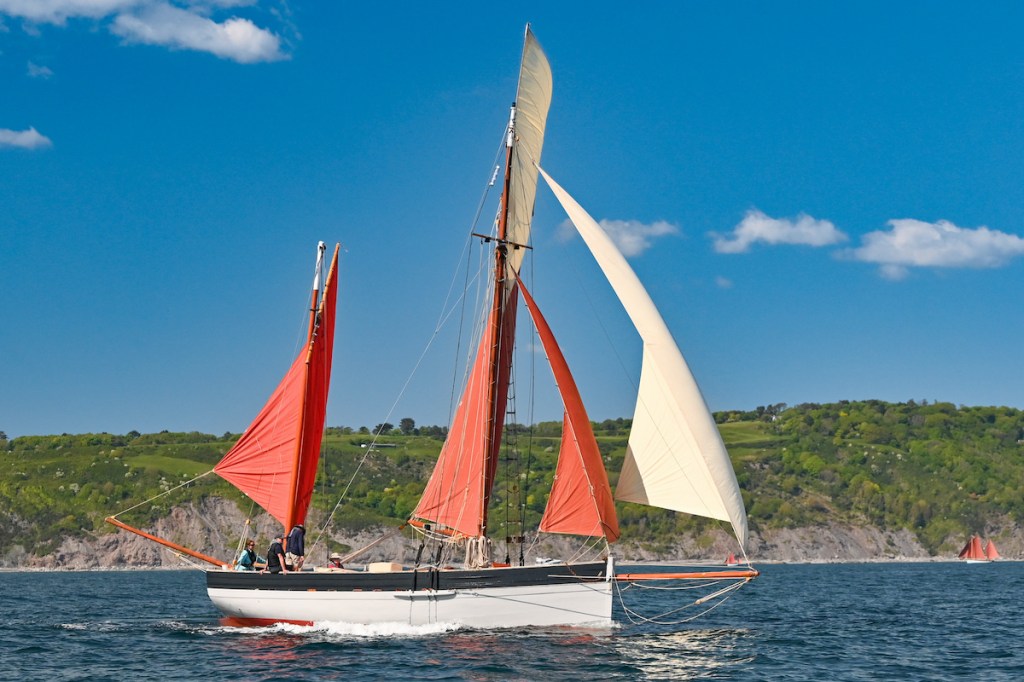
First sight of the sun for three days

The weather is supposed to change when you pass the Pointe du Raz. It’s the dividing line between northern Brittany, which catches the edge of the Atlantic depressions heading for Iceland and Norway that bring the UK’s summer cloud and rain, and southern Brittany, which usually enjoys summer highs over the Bay of Biscay.

And so it did, for an afternoon. Facing a gentle southerly breeze, we motored across the Bay of Douarnenez to be sure of reaching the treacherous Raz de Sein, the narrow passage between the point and the Île de Sein, during its half-hour of slack water in the afternoon. Even then, the water was churning enough to show how dangerous this passage would be with a tide running and stronger winds.

Once through the turbulence, the sun shone from a blue sky and a gentle southwesterly took us to an anchorage at Sainte Evette off Audierne.
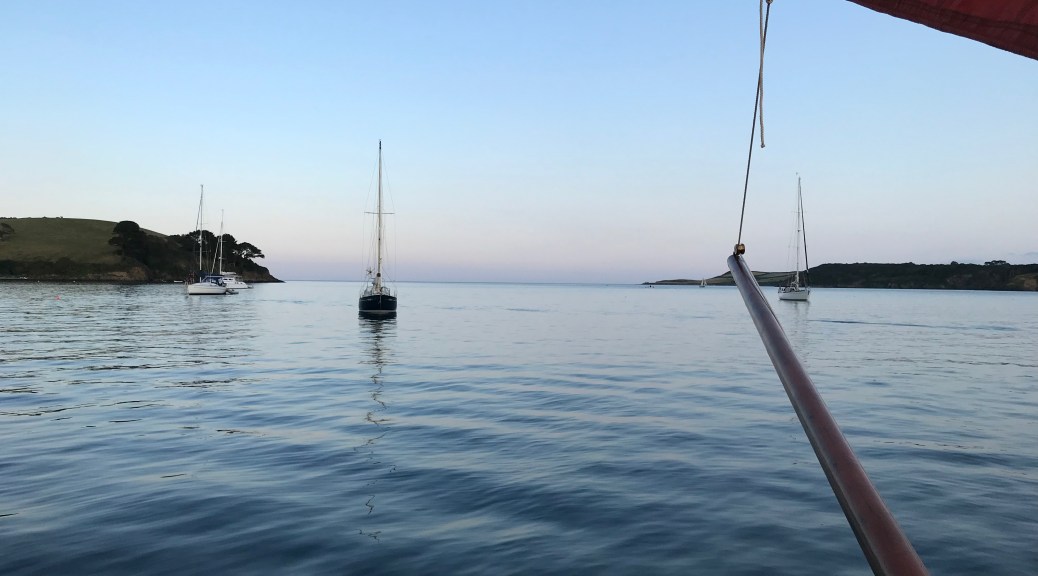
And that was that. The next day, rain beat down and mist closed in. We tacked down the coast of the bay of Audierne for five hours, sailing more than 20 miles to cover little more than 10 over the ground, and had to put the motor on to round the Pointe de Penmarc’h safely.
Once we turned east, the rain eased and we had the wind over our shoulders so we were able to sail most of the 25 miles to Concarneau, straining to see buoys through the mist. Visibility was so poor on the final stretch, though, that we took the sails down three miles from Concarneau and motored.

We had promised ourselves a shower and a fine restaurant meal to recover. But when we arrived, so many other boats were sheltering from the weather in the marina that we were put on a mooring buoy a mile away.

We blew up the dinghy, still determined to go ashore, but then the dinghy engine wouldn’t start: I had failed to drain the fuel when I put it away at the end of last season and the carburettor was clogged with residues left by the evaporating petrol. I can’t blame that on climate change.

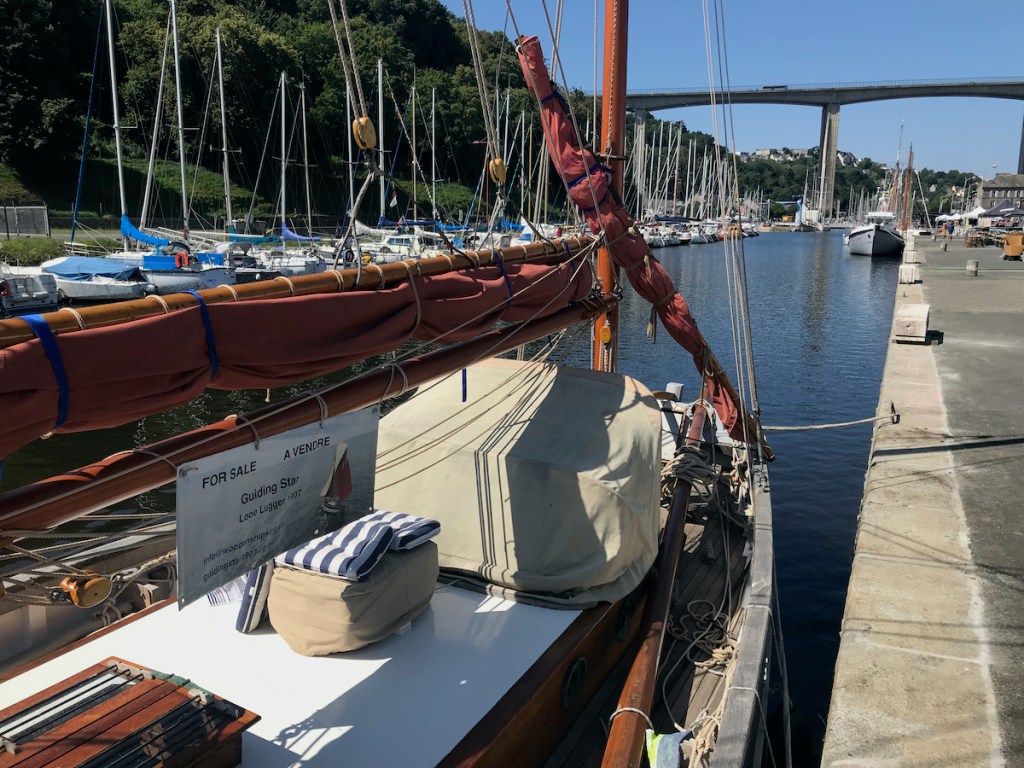
We moved to the marina the next morning, a high pressure system pushed across the Bay of Biscay and I baked on Guiding Star for the next week in 35-degree heat while waiting for new crew to arrive. I even managed yoga on the pontoon with a view of the mediaeval Ville Close, the original walled town of Concarneau which fills an island in the river.

So all ended well. But global heating is wrecking our climate, and wet and windy summer holidays will be the least of our problems.

I only bought six tickets…

This year’s first trip across the Channel in July did not start well. One unlucky crew member arrived in Plymouth without her passport so we were down to three for the crossing; and when we set out next morning into a disturbed sea, I was seasick.

However, the festival we went for turned out splendidly and ended with an unexpected happy twist.

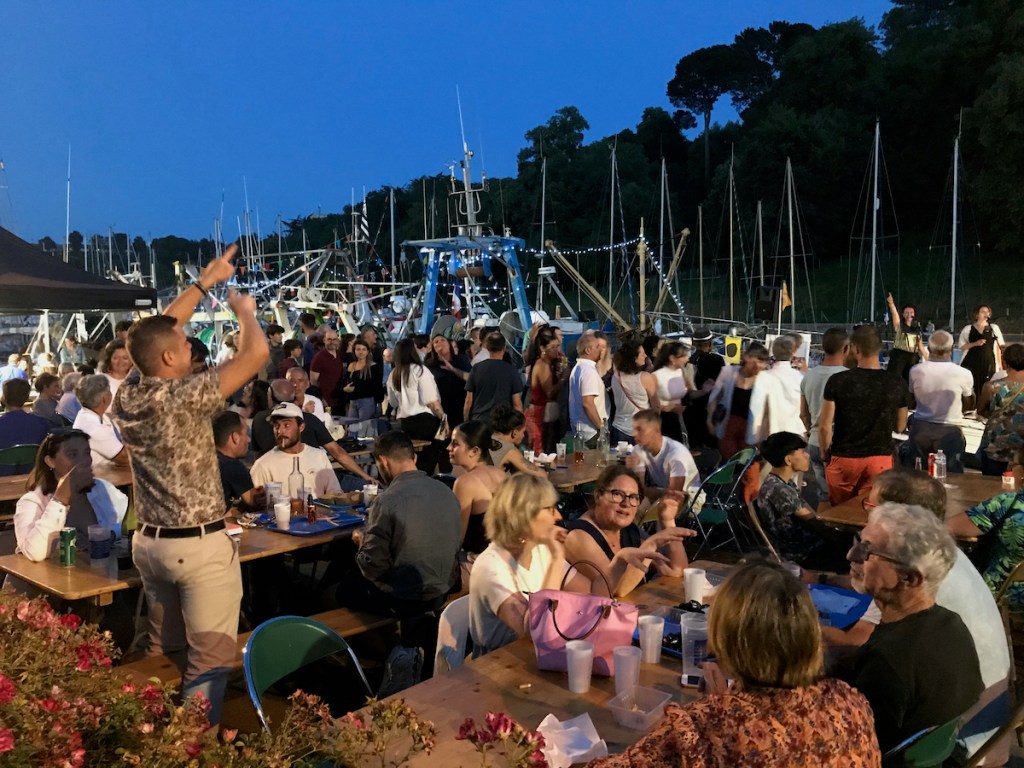
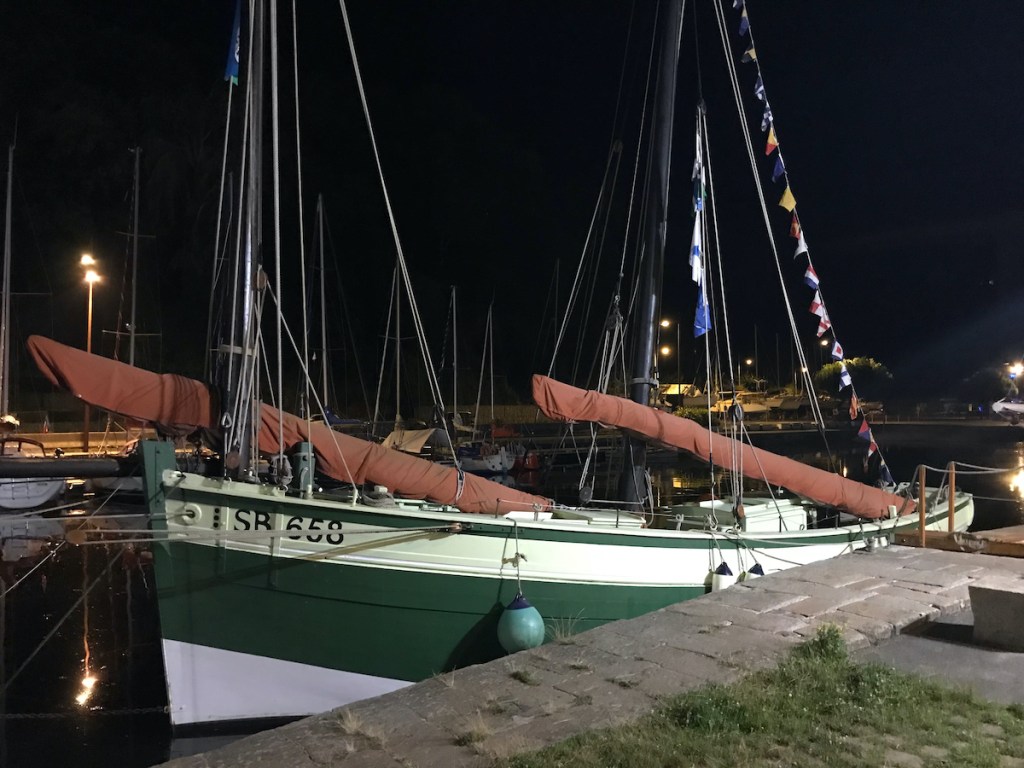
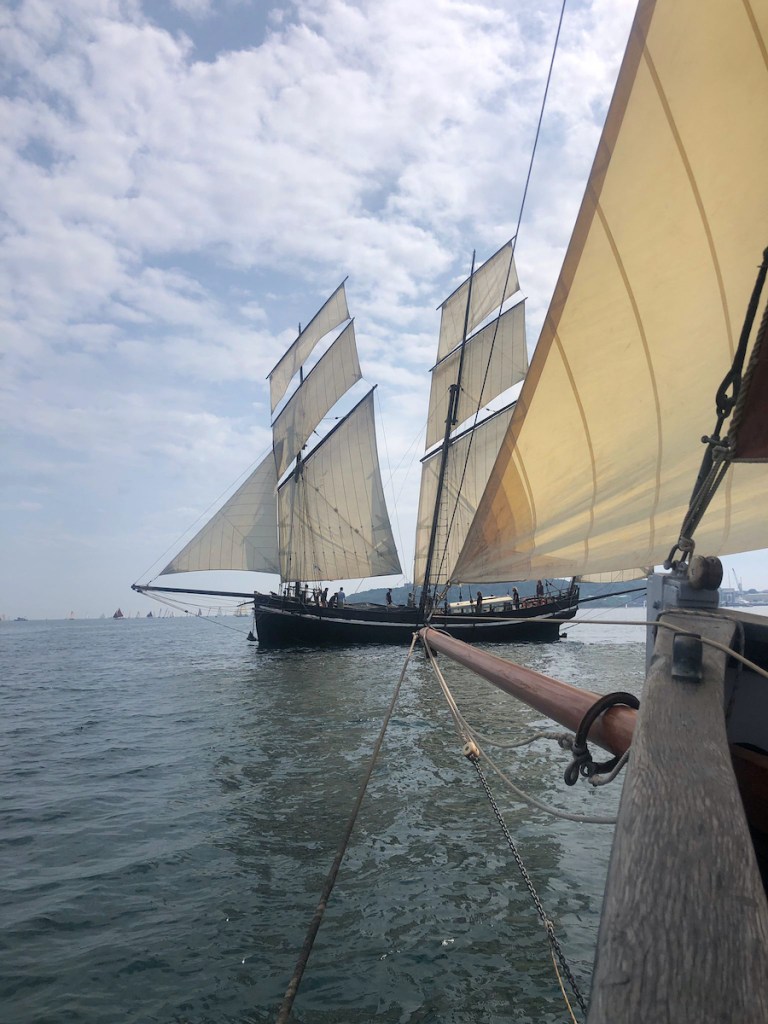
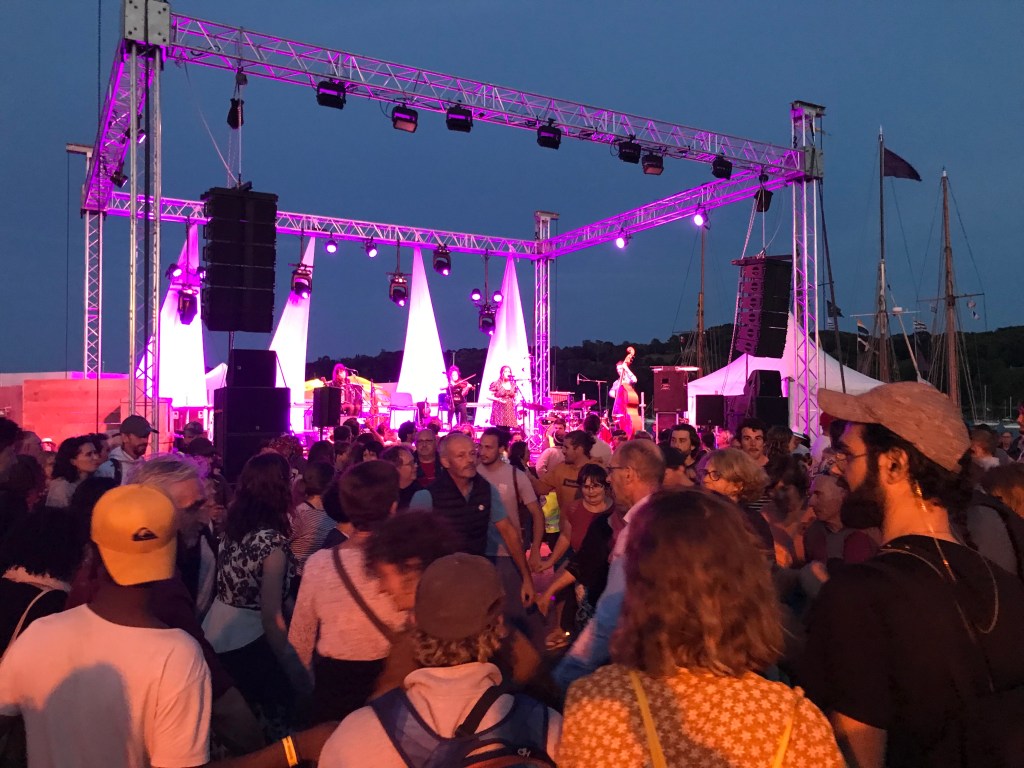
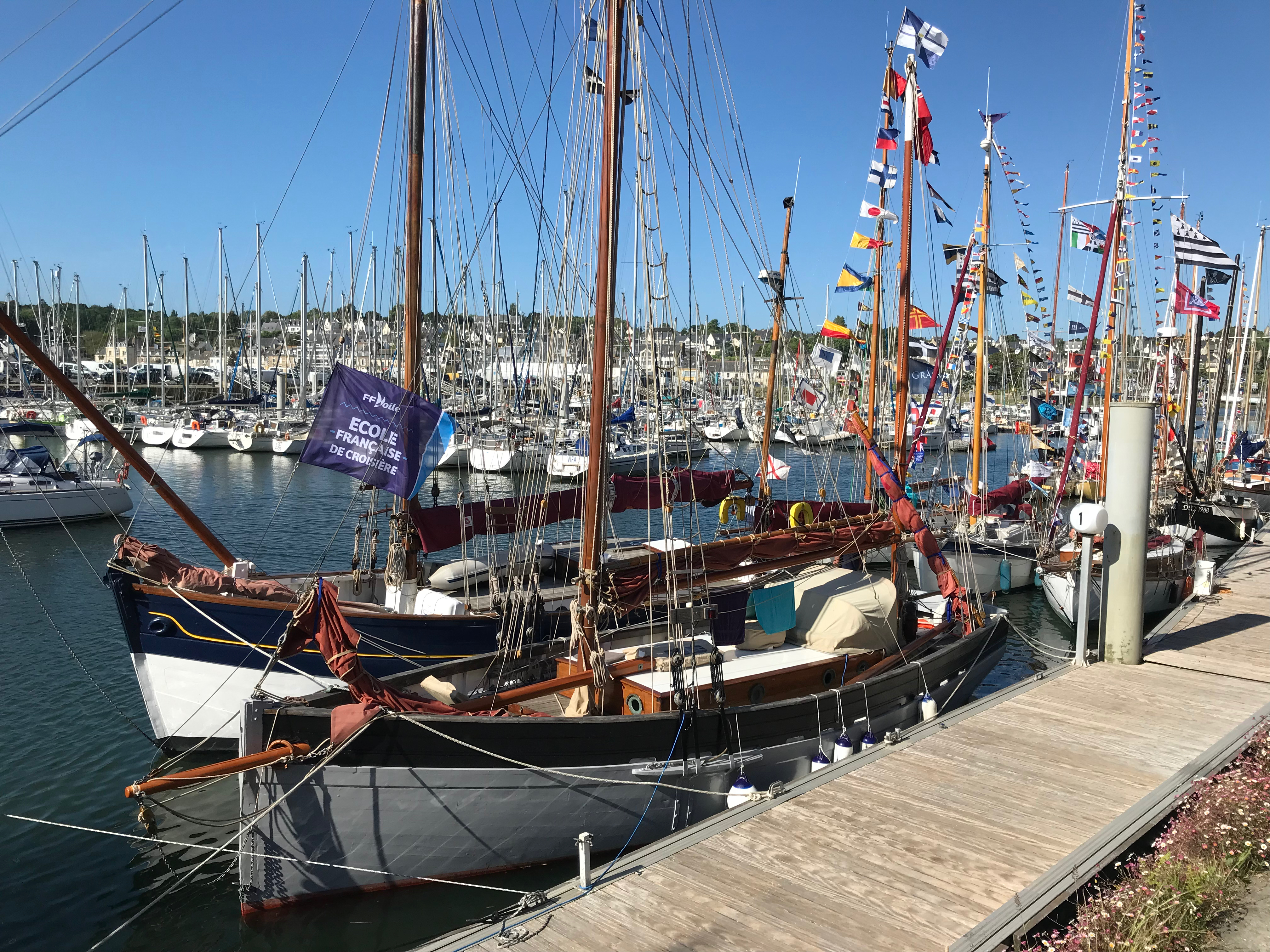
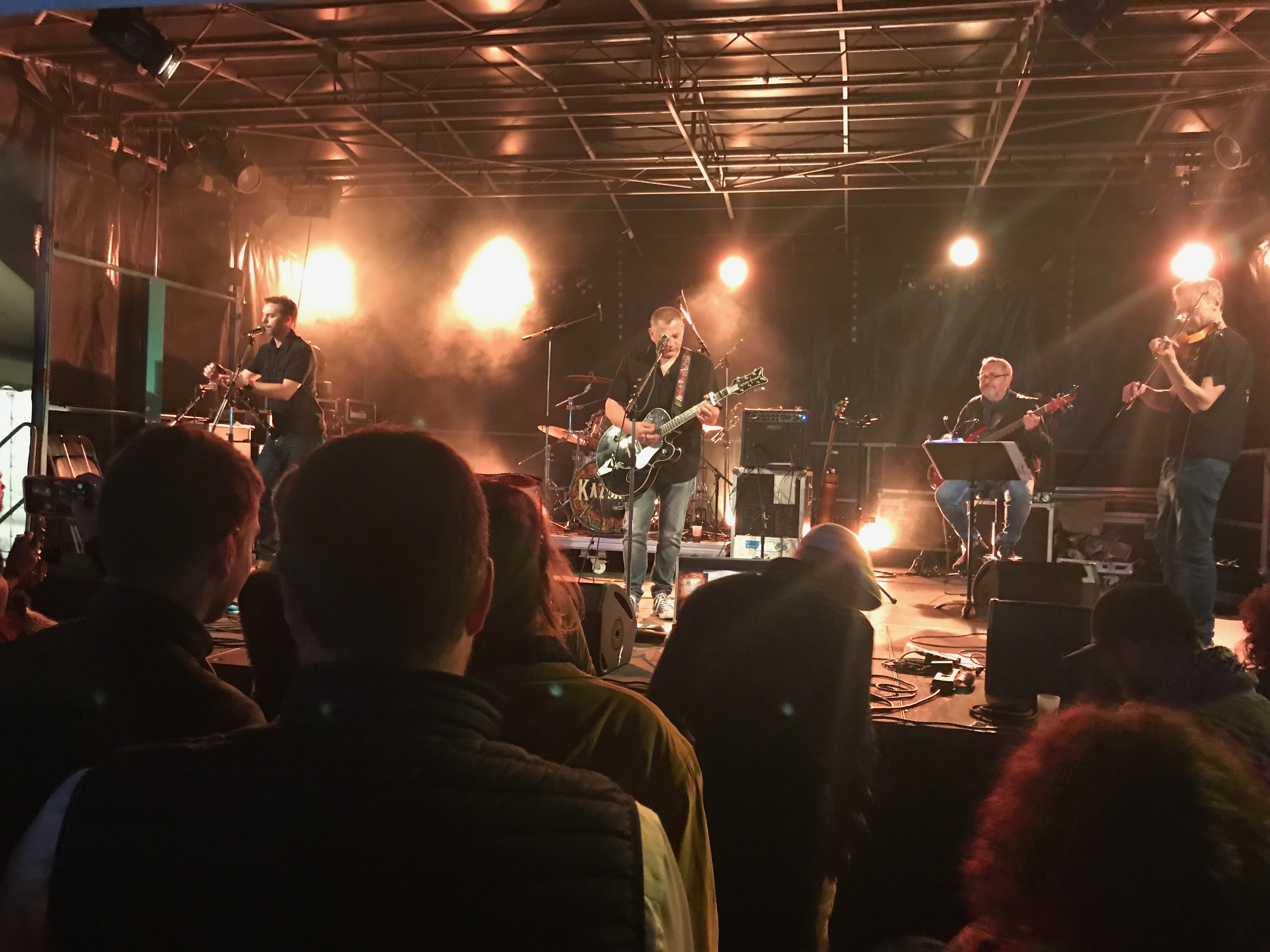
Le Grand Léjon, the replica sand lugger whose crew have always welcomed us warmly to Brittany, was celebrating its 31st anniversary at the same time as the fishers of Le Légué were holding their yearly Festival of the Sea. The local Rugby Club and Fishers’ Association set up tents on the quayside serving oysters, scallops in galettes and mussels and chips, and three music stages offered everything from Bréton pipes to hard rock. John fell in love with the trumpeter and lead singer of the Mama Shakers, “the hot jazz, country-blues band from Paris that will knock your socks off!” They certainly did.

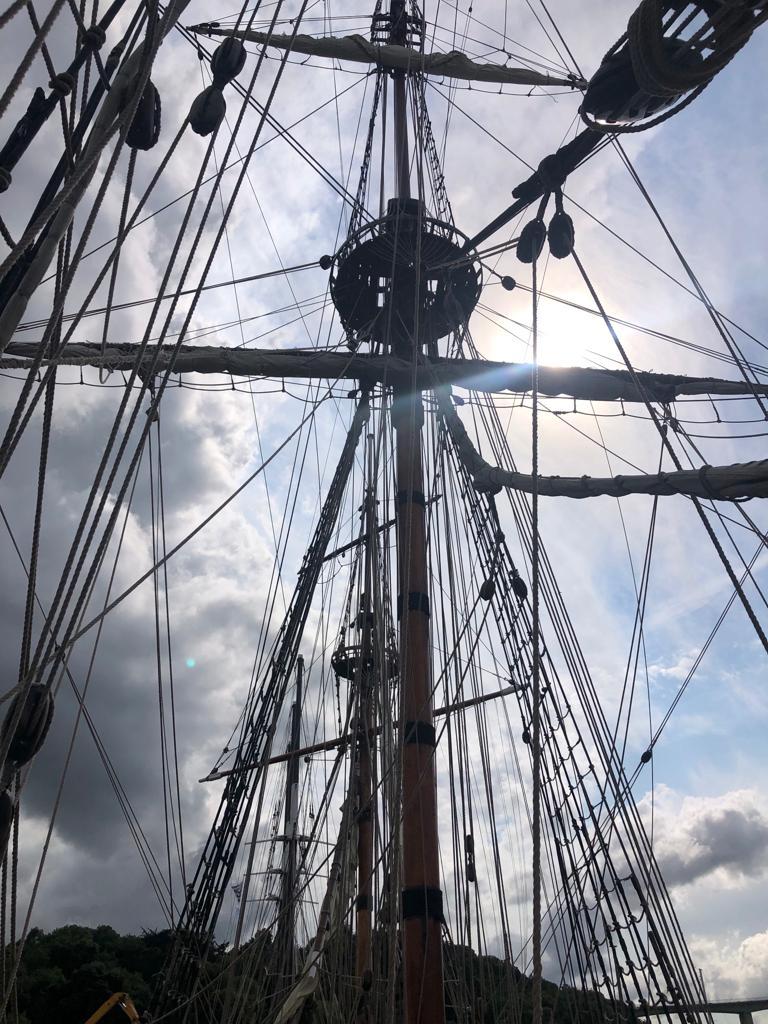
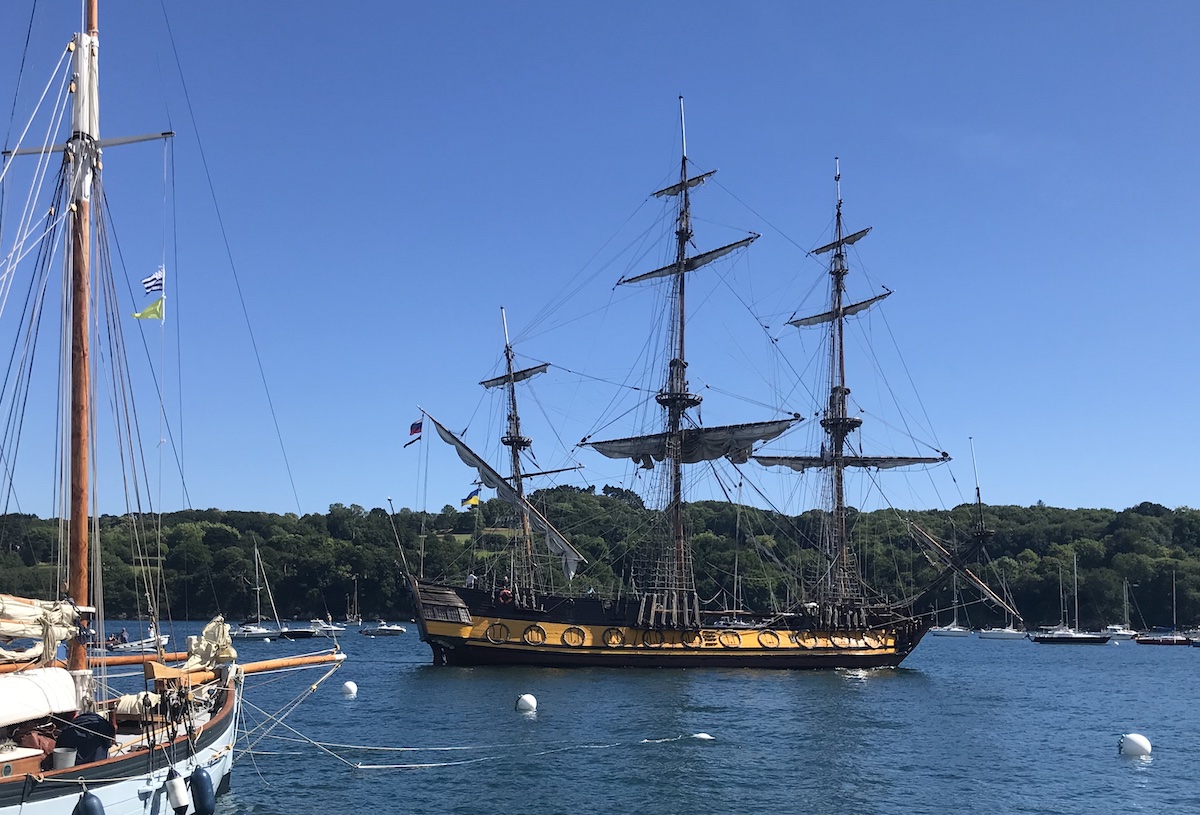
Sadly I took no photographs of John’s and my fascinating tour of one of the biggest boats attending the festival: Shtandart, a meticulous replica of the frigate which Peter the Great of Russia launched in 1703 as the first flagship of the Imperial Russian Navy. But John took one of the rigging and next to it is a photo I took of her arriving in Douarnenez last year. She’s the real deal: 82 feet on deck and 220 tons. I’ve also embedded a video of her at the bottom of this post.

The Tsar learned Dutch and English shipbuilding techniques on a tour of Europe and supervised construction himself, which might explain why the original ship was finished in five months. He captained her on her maiden voyage under the pseudonym “Peter Mihajlov”.

Chris knows the modern Shtandart’s owner and skipper, Vlad, and she has a history almost as amazing as the original. Chris says Vlad raised money and mobilised volunteers in St Petersburg for five years to build the replica as a sail training vessel. But when she was finished in 1999, the authorities demanded that she stay in St Petersburg as a static museum, so Vlad mustered a crew and sailed away at dead of night. They now wander the seas training people to sail an 18th century square rigger, and overwinter in La Rochelle.

On Sunday afternoon when the festival was winding down, Claire Michel from Le Grand Lejon stopped by Guiding Star and asked my mobile number. When I had given the first few digits, she interrupted and said, “You’ve won something!”

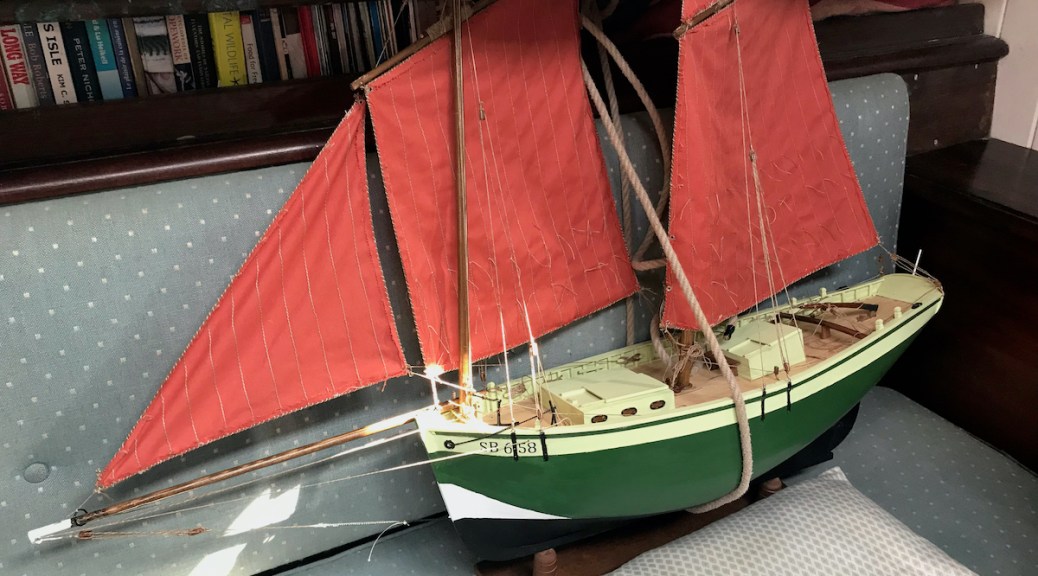
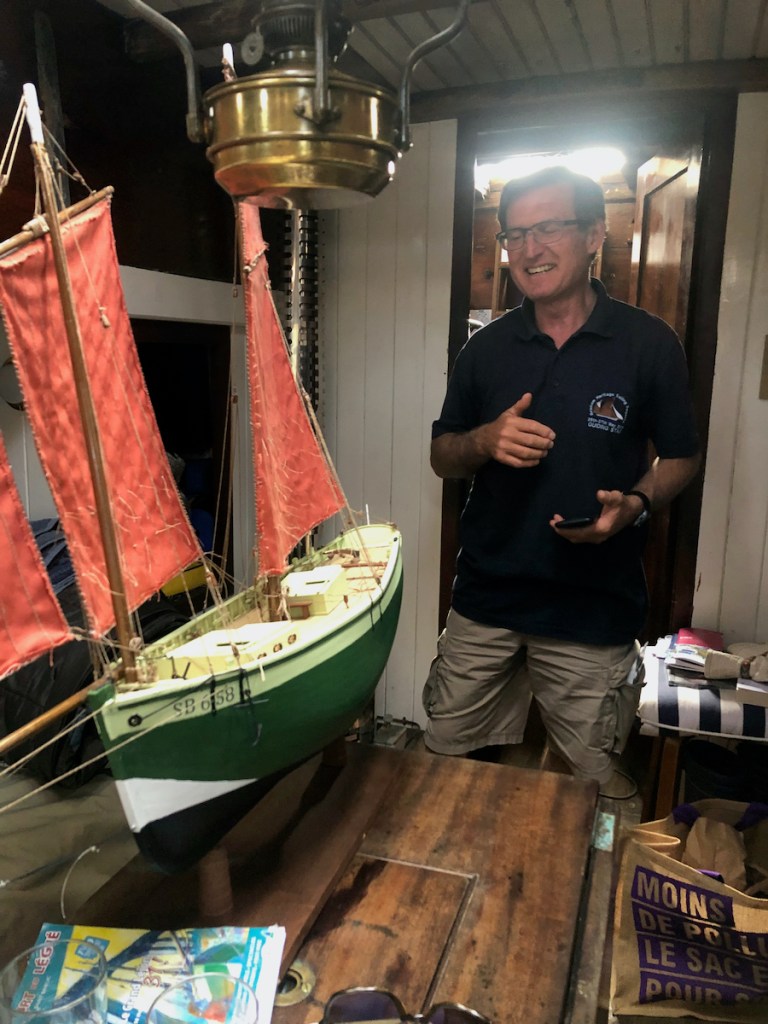
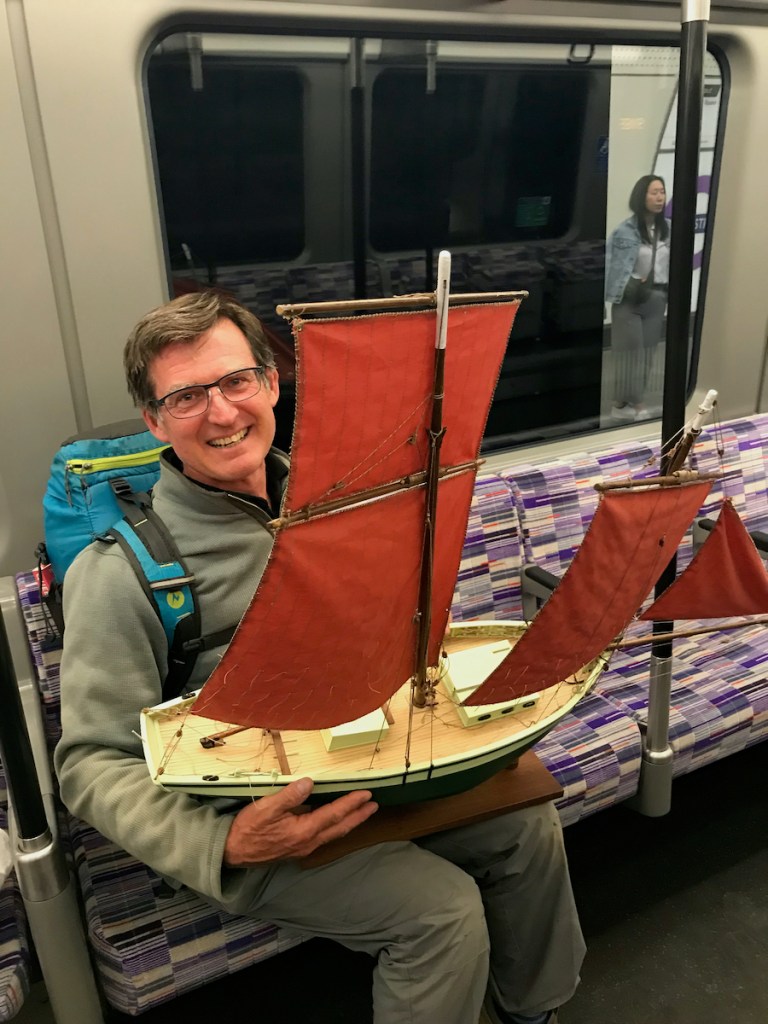
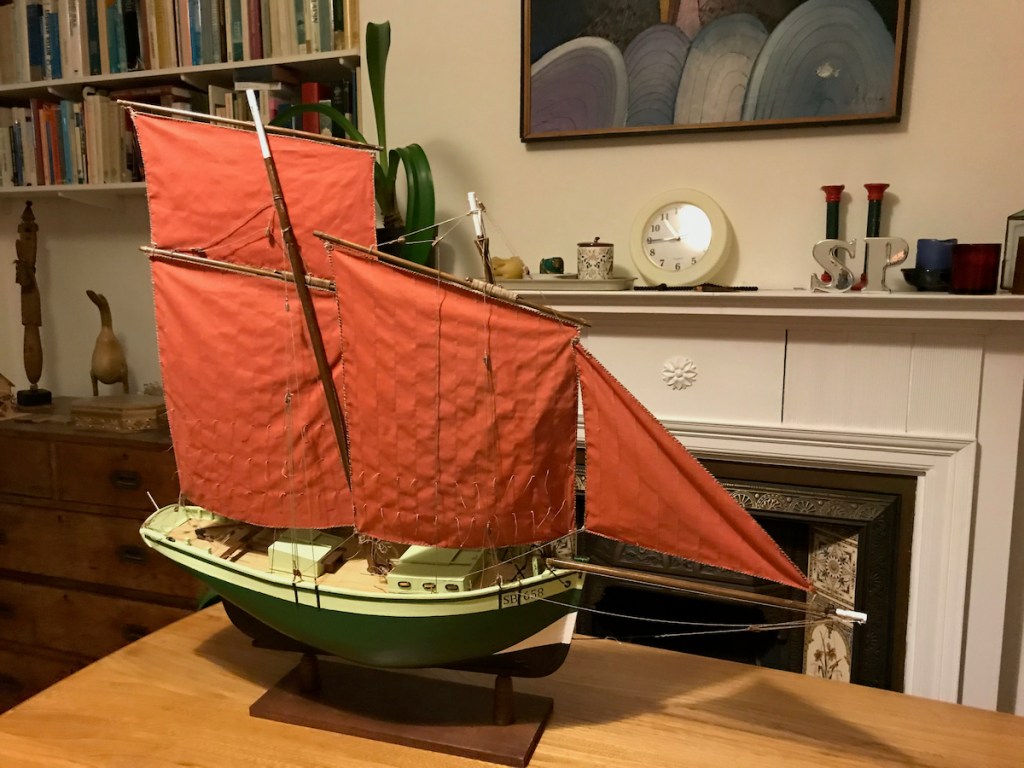
I was overwhelmed to discover that I’d won a raffle organised to raise funds for the non-profit association which runs Le Grand Léjon, and the first prize was a stunning metre-long replica of the boat itself made by the father of one of the crew. I had bought half a dozen tickets to show support but had never imagined I might win.

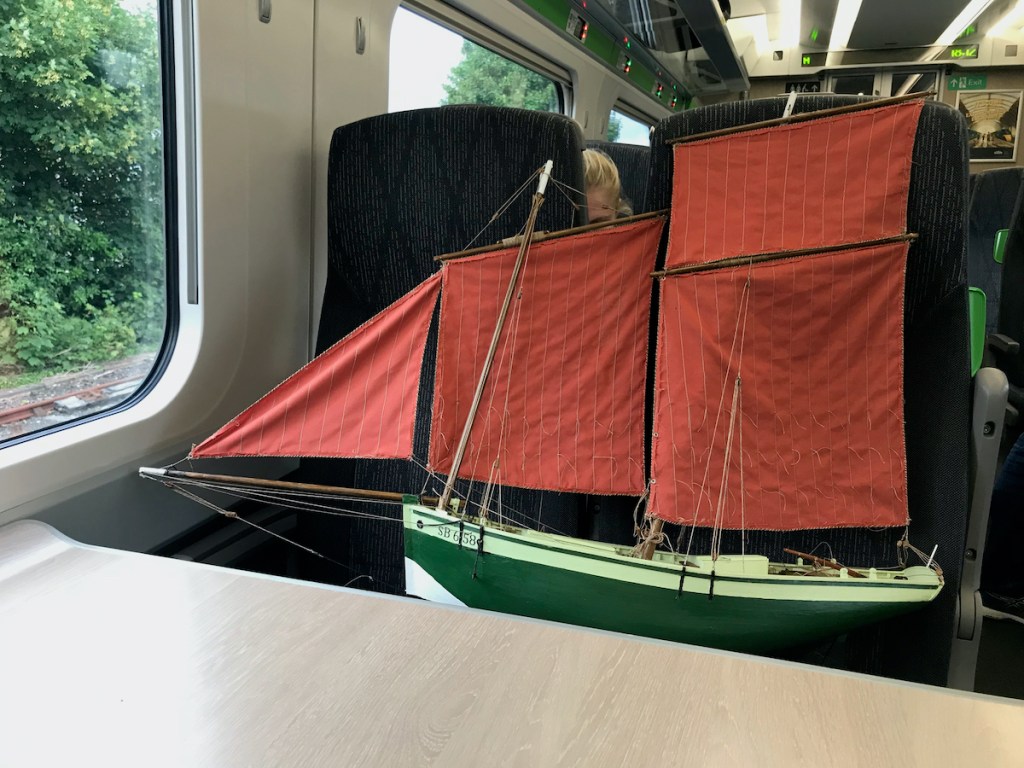
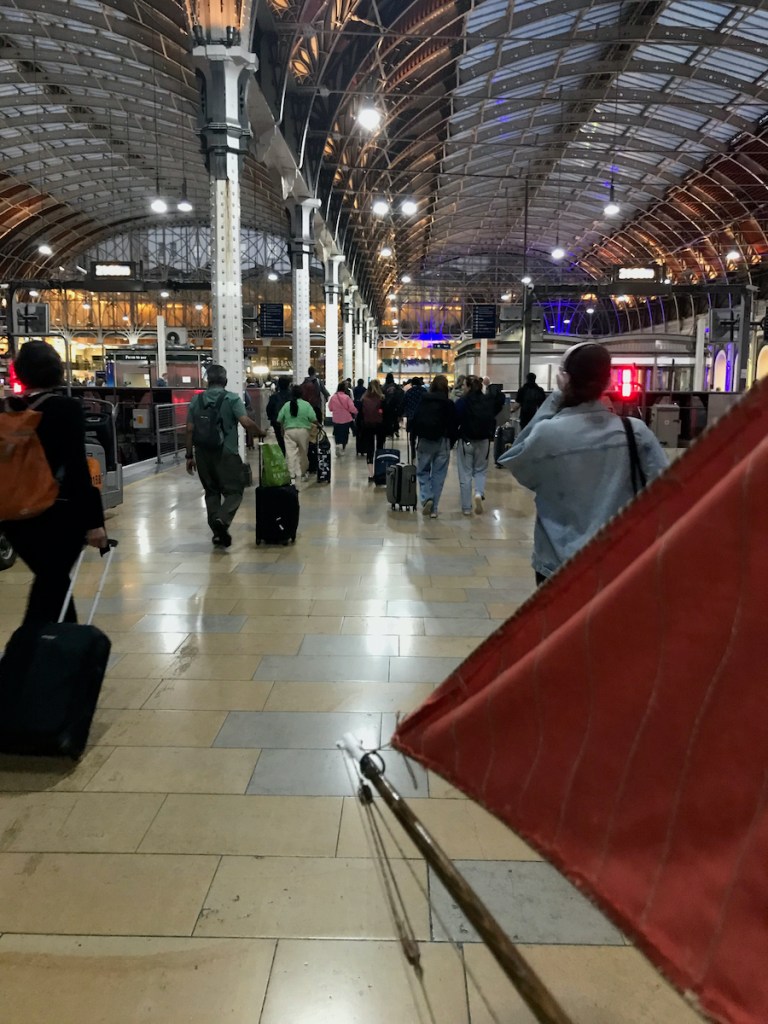
We manoeuvred the model through the main hatch into the cabin and I wondered how on earth to get it home to north London: first a channel crossing on Guiding Star, then a bus to Plymouth station, a mainline train to London, two London underground rides and finally another bus.

In the end, everything went well until I stood up to get off the last bus, when the bus lurched and the wooden stand fell off. I picked up the pieces and here she is in my front room. The deck took some seawater drips during the Channel crossing, as decks do, and some spots of black mould had formed. But I managed to clean them off with meths and tidy up the miniature lines. What a souvenir!

Shtandart

First in Falmouth

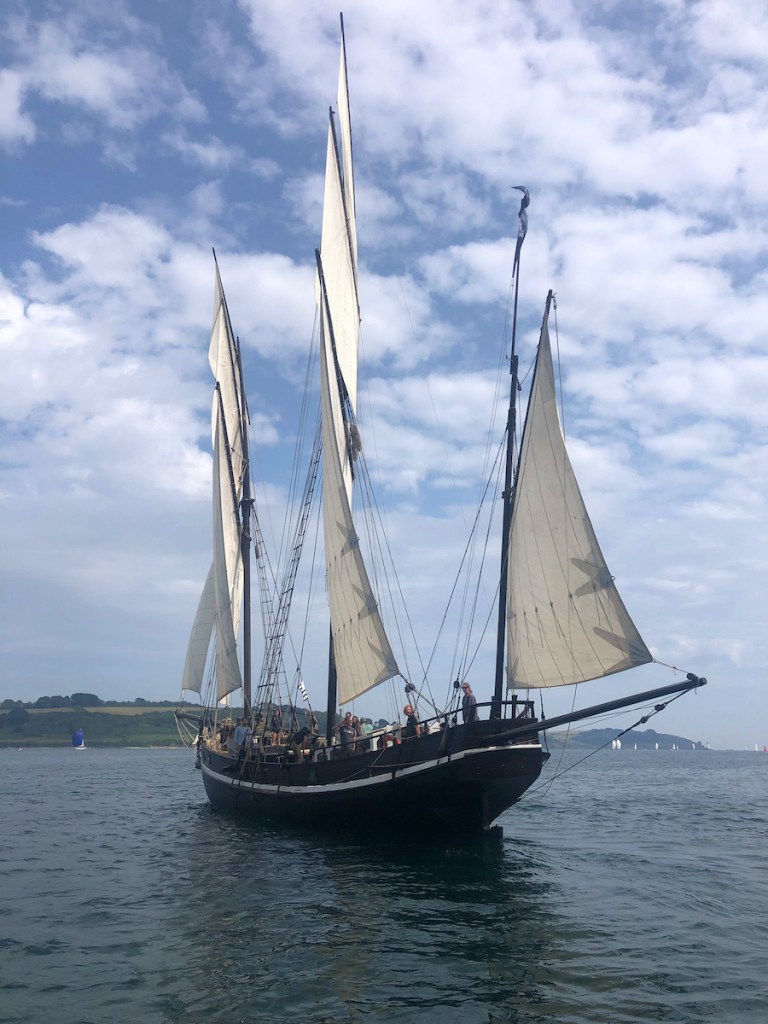
Guiding Star sailed beautifully in light airs at the Falmouth Classics in June. We won the Lugger class, admittedly against weakened competition. Our Boys didn’t come because Phil and Liz were sailing their new boat Alice back from Antigua, Barnabas had been crippled by having to chop five feet off their mainmast because of rot, and Grayhound was not sailing as fast under her new owners as she used to under Marcus and Freya.

Pirates ahoy

Our finest moment came shortly after the start of the first race, when Grayhound tacked and tried to overtake us from windward. She’s 63’6″ without her spars and 60 tonnes, so nearly twice as long and four times as heavy as Guiding Star. The last time she tried to bulldoze us at Falmouth a few years ago, we decided it was safer not to insist on our rights under the rules (the windward boat gives way) and meekly turned away.

This time we held our course, sailing as close as we could to what little wind there was, forcing Grayhound to sail even closer to the wind so that she lost speed. After a tense few minutes when the finely-costumed pirates on Grayhound’s deck seemed almost on top of us, they gave up and tacked away.

Pirates tack away

In fairness, there was so little wind that a vessel of Grayhound’s weight was doing well to move at all. We left them and Barnabas far behind but still took two hours to reach the windward mark under St Anthony Head, where the race was declared over.

We came first in all three races, each of myself, Peter and Chris helming one and Bart doing sterling work on the sheets.

‘Here’s a rum and shrub for the shantyman’

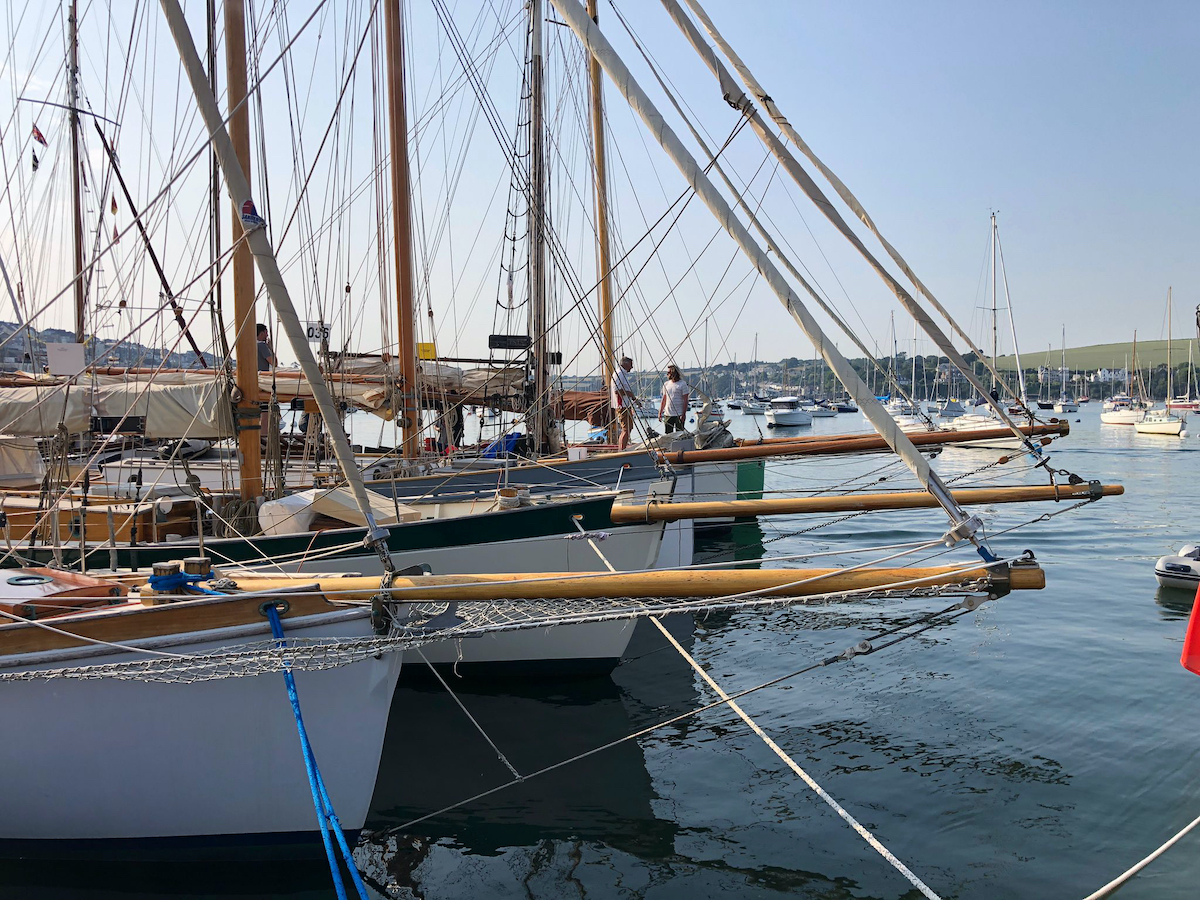
Guiding Star had a fine berth at the corner of the two outside pontoons in Falmouth Haven and it was fun to be chosen as the stage for the Rum and Shrub Shantymen. Shrub is a strong-tasting mixture of alcohol, sugar, citrus juice and spices which Cornwall’s eighteenth-century smugglers brewed to disguise the taste of rum which had gone salty from being stashed in leaky barrels under the sea. You can still buy a commercially-made shrub from Sevenstones or you can cook your own.

We just had time before the shantymen struck up to hang Guiding Star’s For Sale banner above their heads hoping to catch the eye of the crowds milling around with their beer and pasties on the pontoon.

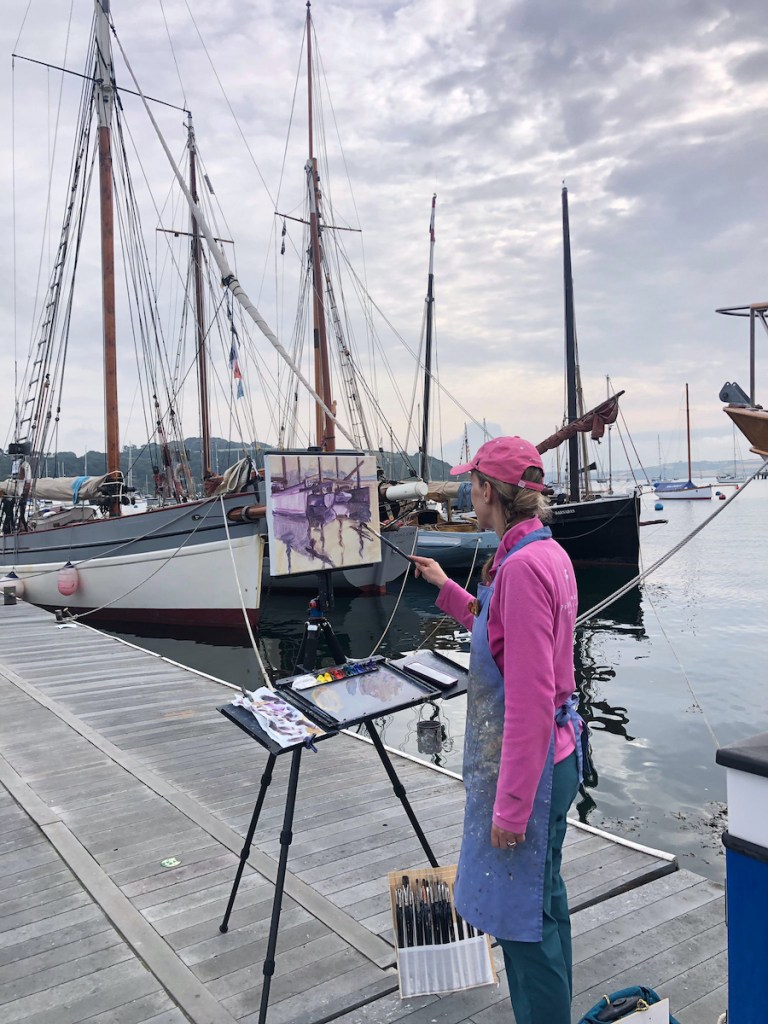
A painting of our boats on the pontoon is now hanging on someone’s wall! Artist Clare Bowen painted two pictures and submitted them for the Royal Society of Marine Artists’ annual exhibition at the Mall Galleries in September. One was accepted and has already sold.

Clare Bowen painting our boats.

I spent Saturday and Sunday afternoons up the mast fitting a new VHF antenna, seizing the chance that Peter started his career as a radio operator and knew exactly what to solder onto what. But on Monday afternoon on the way to Fowey when we hoisted the topsail with the wind behind us, the yard risked banging against the antenna bracket so once back in Plymouth I went up again to move it to the other side of the mast.

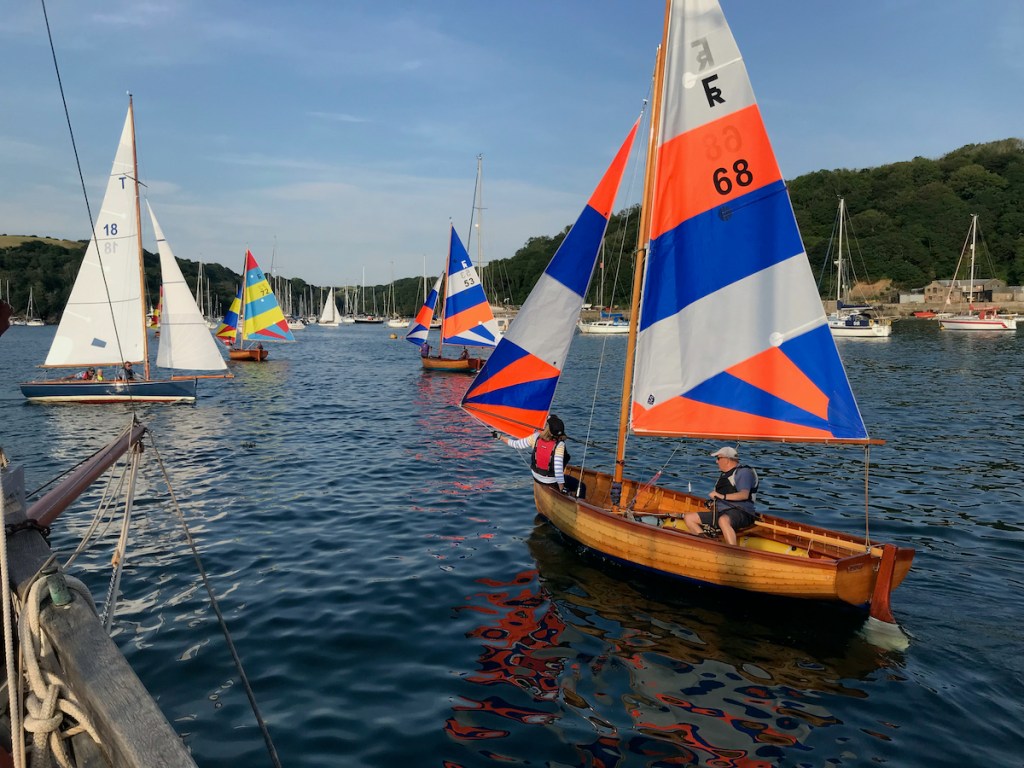
We arrived in Fowey as we often seem to do right in the middle of evening racing by the Fowey River class dinghies (15′) and the bigger Troy class boats (18′). The coloured sails make a magnificent sight but there are a lot of boats to avoid when you’re picking up a buoy. It’s different if you’re Border Force on a mission: a RIB full of tough-looking types in black helmets and flak jackets roared straight through the race to board a dodgy-looking big yacht on the buoy next to us.

Many thanks indeed to Chris, Peter and Bart for a wonderful week’s sailing, and for several of these photographs.

Best Endeavours in Looe

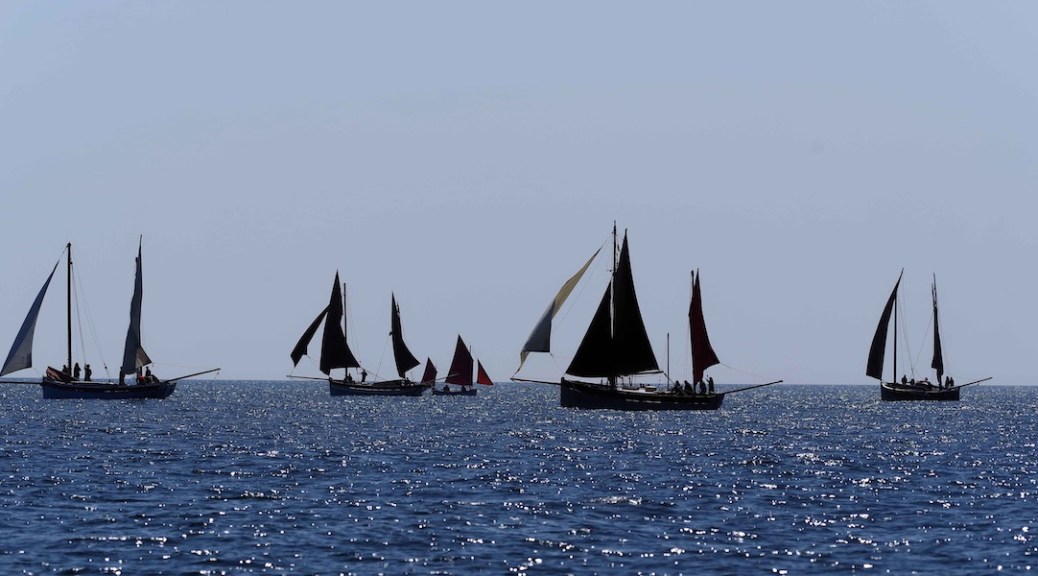
We were never going to beat the lifelong lugger sailors who lead the Looe Lugger Regatta fleet but we worked hard and came away with fourth place in all three races. The Committee awarded us a trophy for ‘Best Endeavours’ which means trying hard.

Messy start after a wind shift. Photo by Philippe Saudreau

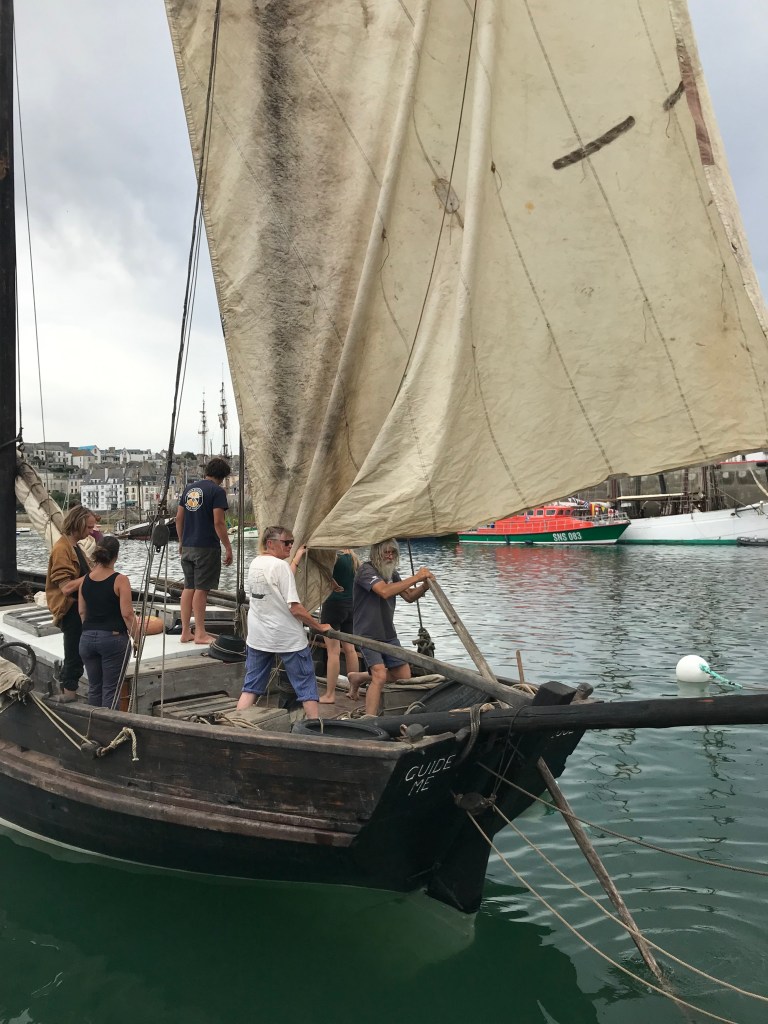
Guide Me won every race in May’s Regatta, of course, because she always does. She has no engine, so she’s a little lighter for the amount of sail she carries than other boats, and Jude and Jono Brickhill and their family and friends sail her superbly. Her hull shape is very similar to Guiding Star’s but she just seems to hiss through the water as if she’s blown by a wind of her own.

Nick Gates’s Ocean Pearl and Graham Butler’ s Reliance battled it out for second and third places. We managed to keep in touch with them except in one race when we mis-read the strength of the flood tide sweeping round Looe Bay. Ocean Pearl went far out to sea, Reliance went right inshore, and we went down the middle and lost ground to both of them. The two community association boats, Barnabas and Happy Return, brought up the rear.

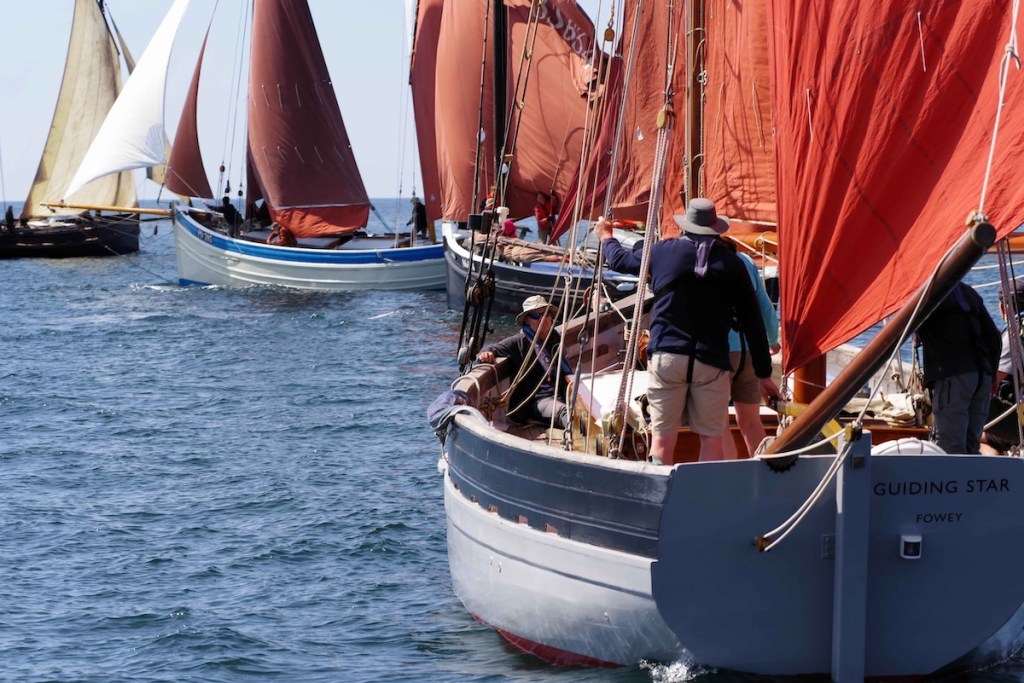
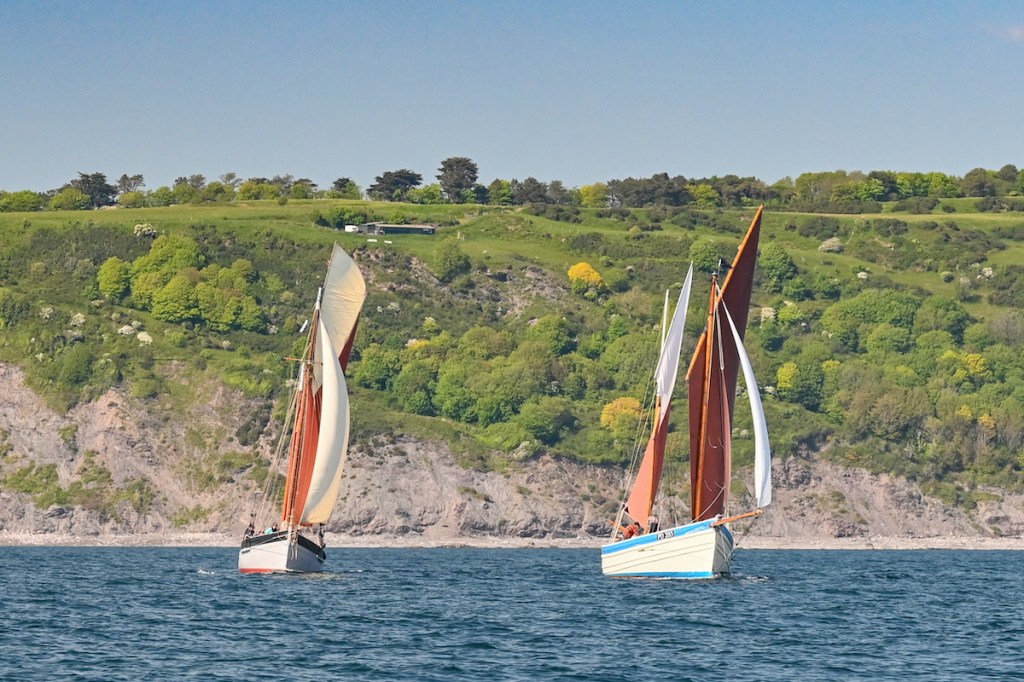
Right to Left: Guiding Star, Guide Me and Ocean Pearl

The day before the Regatta when the boats had dried out against the West Looe wall, Nick and I spent some time splashing around in the mud comparing hulls. Nick quoted an old fishing skipper as saying that if the first ten feet of the boat were hollow, she’d be fast; if they were straight, she’d be all right; and if they were bluff, she’d be slow. Guide Me and Guiding Star are both slightly hollow. Ocean Pearl doesn’t look like she should sail fast at all and in fact she was built as a motor fishing boat but Nick converted her and she sails like a dream.

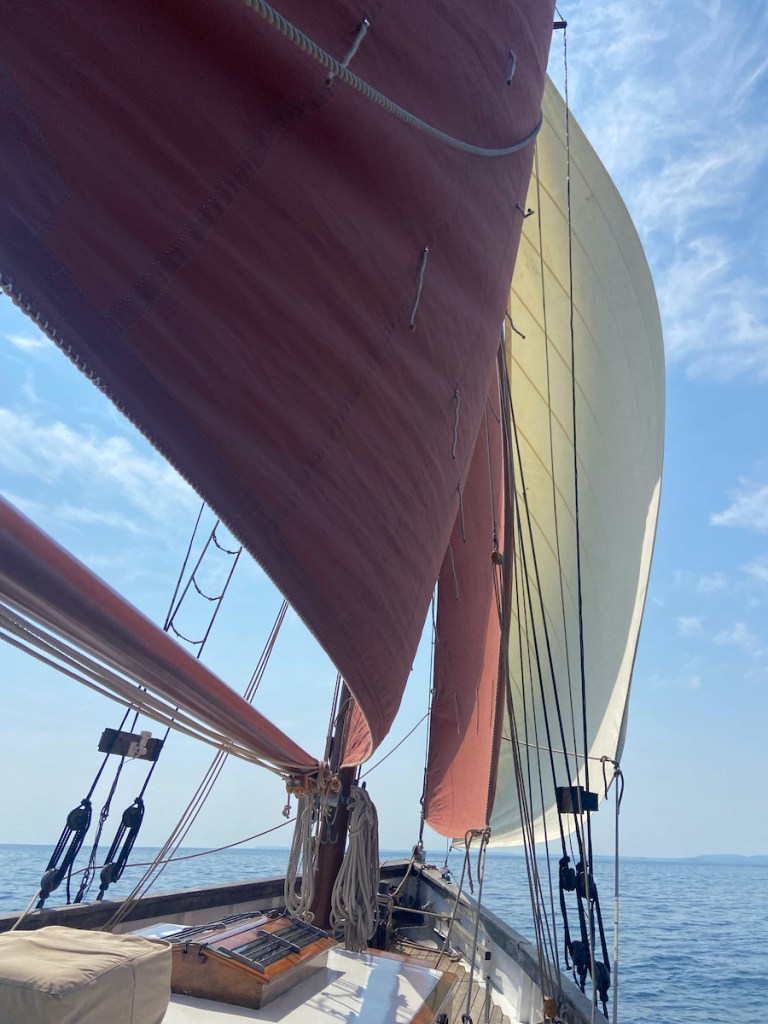
The cloudless, almost windless weather was perfect for sunbathing and ideal for the larger sail plan which Chris Rees designed four years ago to make Guiding Star faster in light airs. We had an experienced crew who knew the boat well so the new, bigger topsail set beautifully (or at least as well as it ever will with a bendy windsurfer mast as the yard) and the genoa pulled strongly into the wind as well as off. If the skipper had been brave enough to hoist the genoa before the beginning of each race rather than after, we would have gone even better.

Many many thanks to Chris and Paul, Adrian, and Francoise and Peter for a wonderful two days on the water.

Happy winners of the Best Endeavours cup
Happy winners. Chris, Francoise, Paul, Peter and Paul. Sadly Adrian had to leave before the prize giving

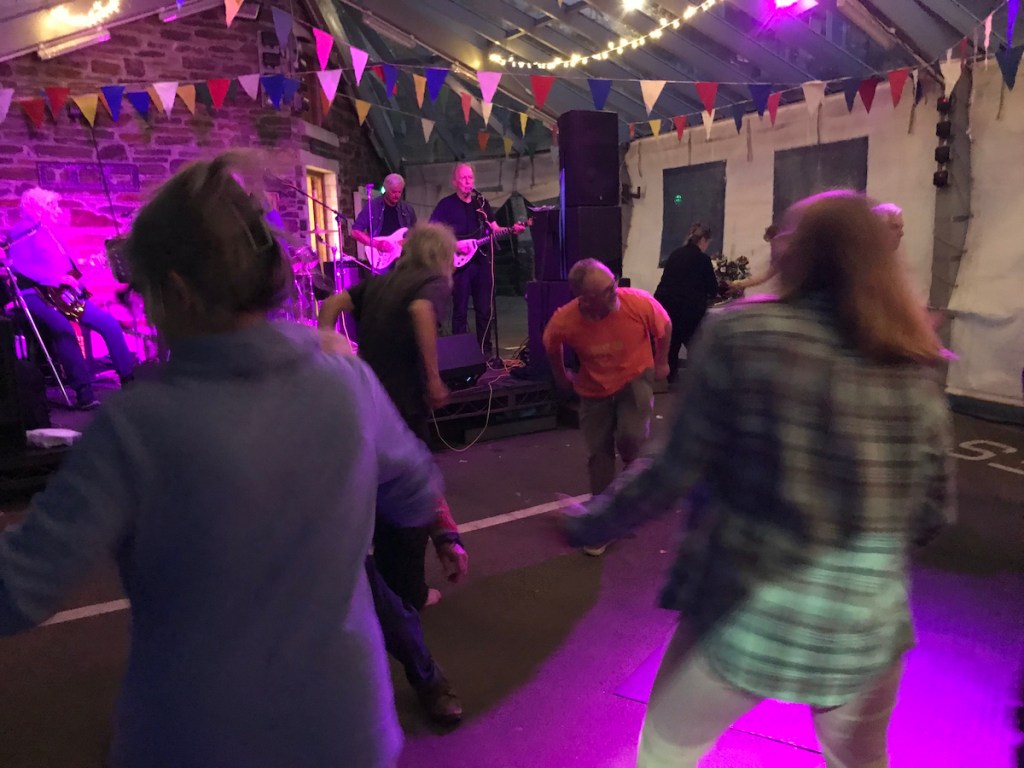
We had nearly as much fun on land. The Polperro Fishermen’s Choir were superb. They’ve been going since 1923 and are in a different league to many shanty groups. I was glad that the Regatta organisers decided they should stand on Ocean Pearl rather than Guiding Star, though, because there were quite a lot of them. Then we had rock till late in the West Looe Quayside Centre.

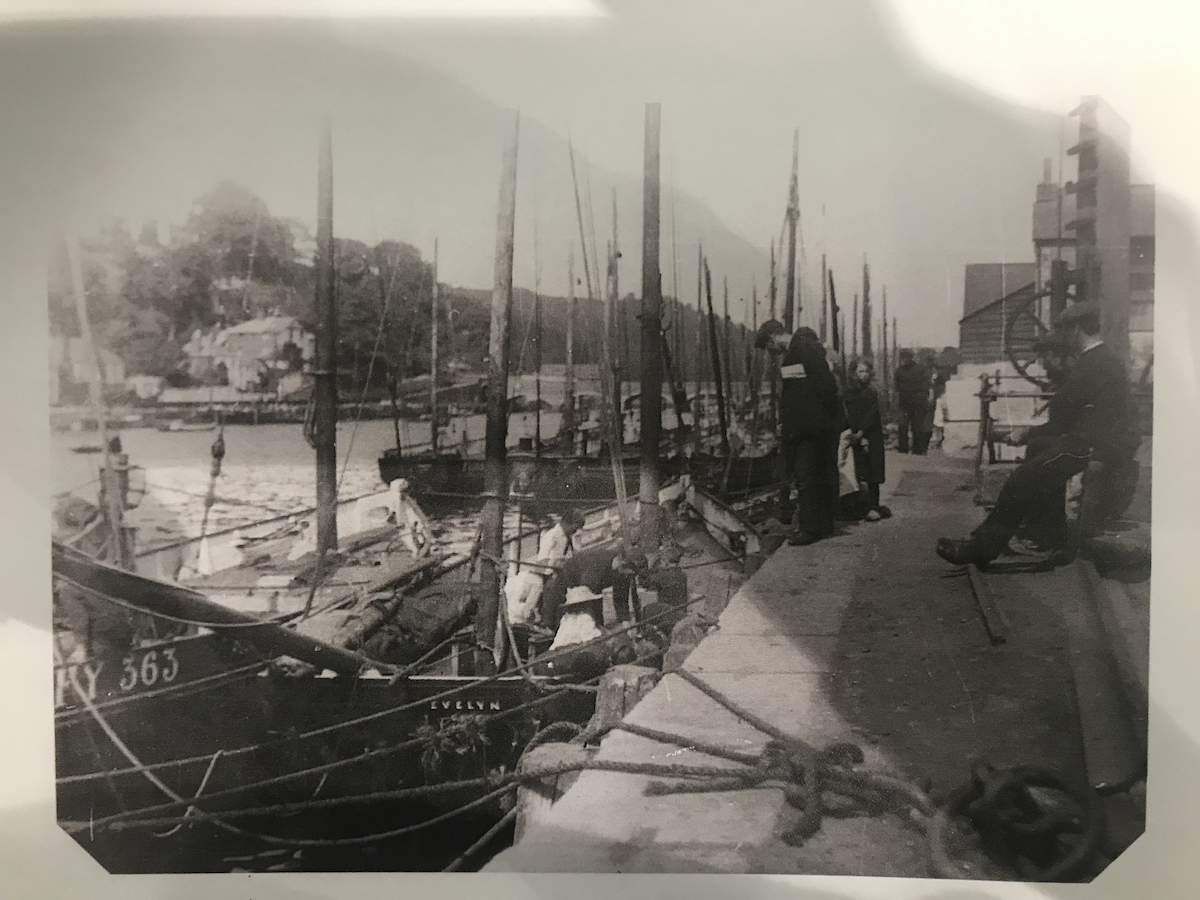
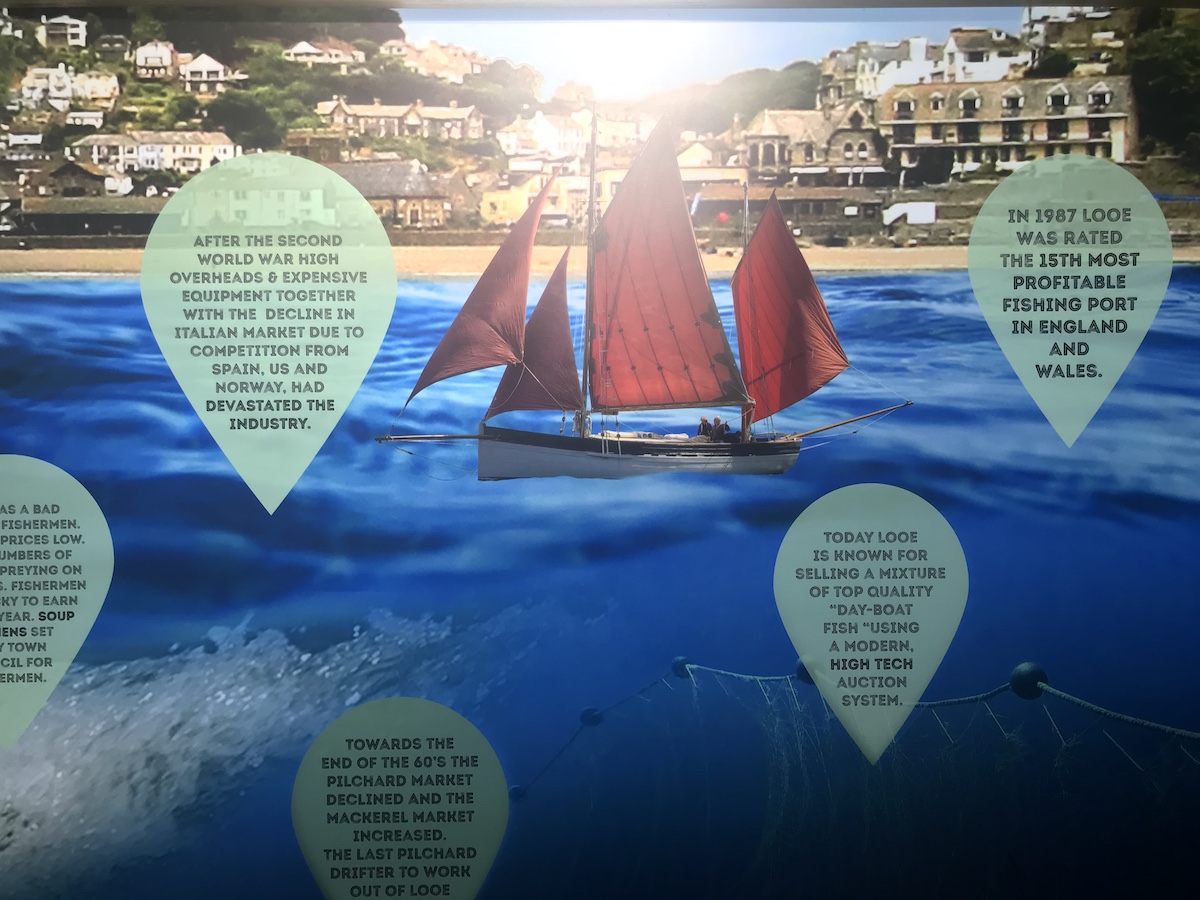
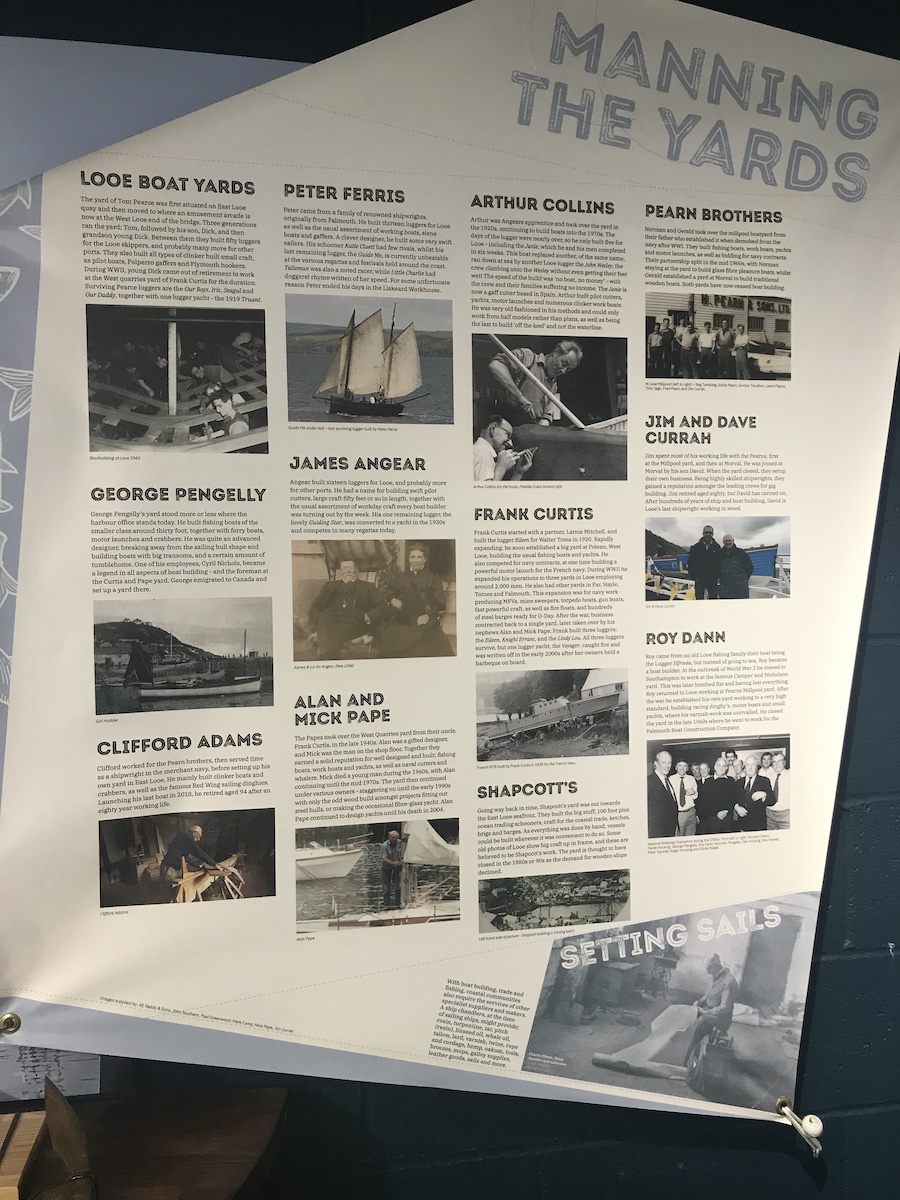
We had Friday free before the racing on Saturday and Sunday so I had the chance to see the Looe Harbour Heritage Centre in the old Sardine Factory a little further down West Looe Quay for the first time. I was excited to find two photos of Guiding Star and a paragraph on her designer and builder, Jim Angear. I learned much about Looe: that her fishermen fished off the Newfoundland Grand Banks in the 17th and 18th centuries; and that the port did big business exporting granite and copper and importing coal for mining engines. The Heritage Centre cafe also does extremely good tea and cake.

Fishing has always had booms and busts. Paul Greenwood, the co-founder of the Regatta and author of two very funny and informative memoirs of working on the old luggers, told me that one of the worst years was 1935 after Italy invaded Abysinnia and the League of Nations imposed trade sanctions, cutting off Looe’s exports of dried pilchards which used to be sent to Italy as pilgrim food.

“It caused a lot of poverty,” Paul said. “Five boats were sold in one day.” So it’s no surprise that Jim Soady sold Guiding Star out of fishing in 1936.

Thank you to everyone who helped!

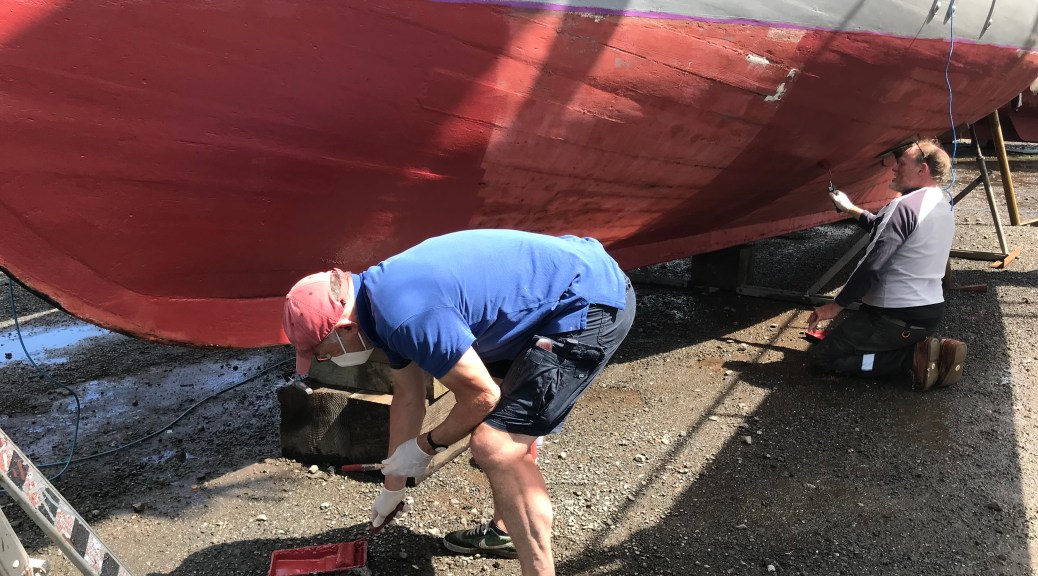
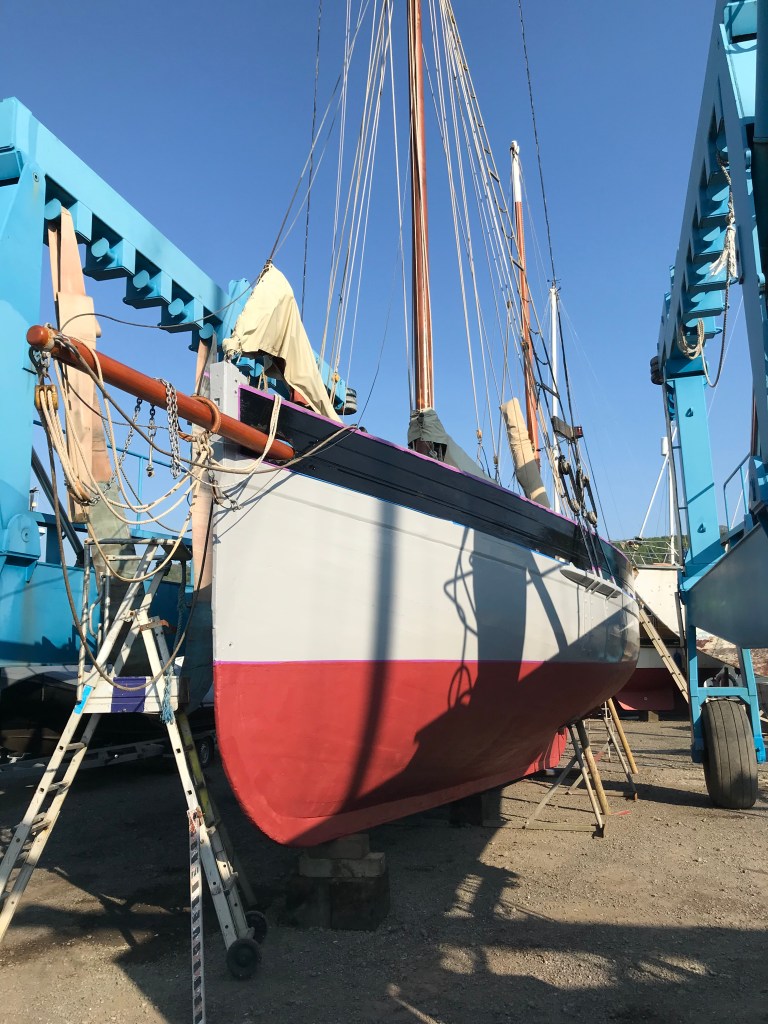
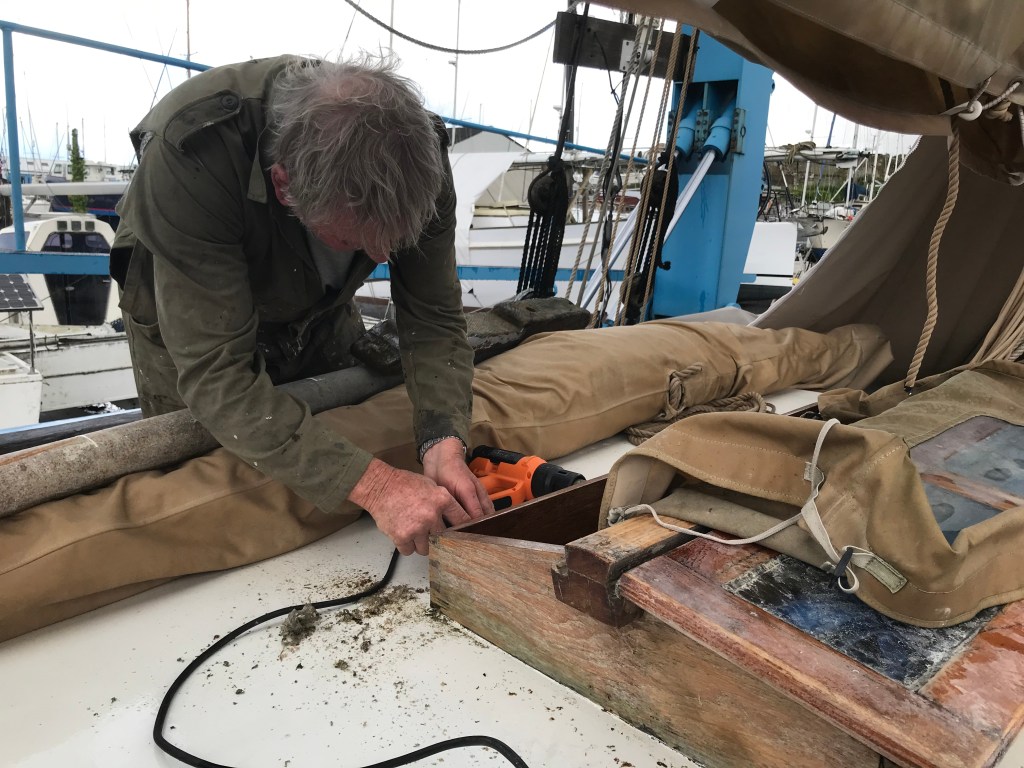
Guiding Star is looking better than ever because of all the crew who came and helped to sand, scrape, paint and varnish. We managed every job on the list including stripping and varnishing the skylight and glossing the covering board. I’m very grateful to Peter, Paul and both Chrises for all the time they gave to the boat.

The weather was wet and cold for the first few days but then a high pressure system settled in and we worked in warm sunshine for day after day. Peter blew up his paddle board one golden evening and I did my early-morning yoga.

The Coronation fell in those first, wet days. I had thought of watching some of it in the marina wash block where the television on the wall is always tuned to the BBC News Channel. I caught ten minutes but nobody else seemed bothered and I didn’t want to leave Peter sanding on his own.

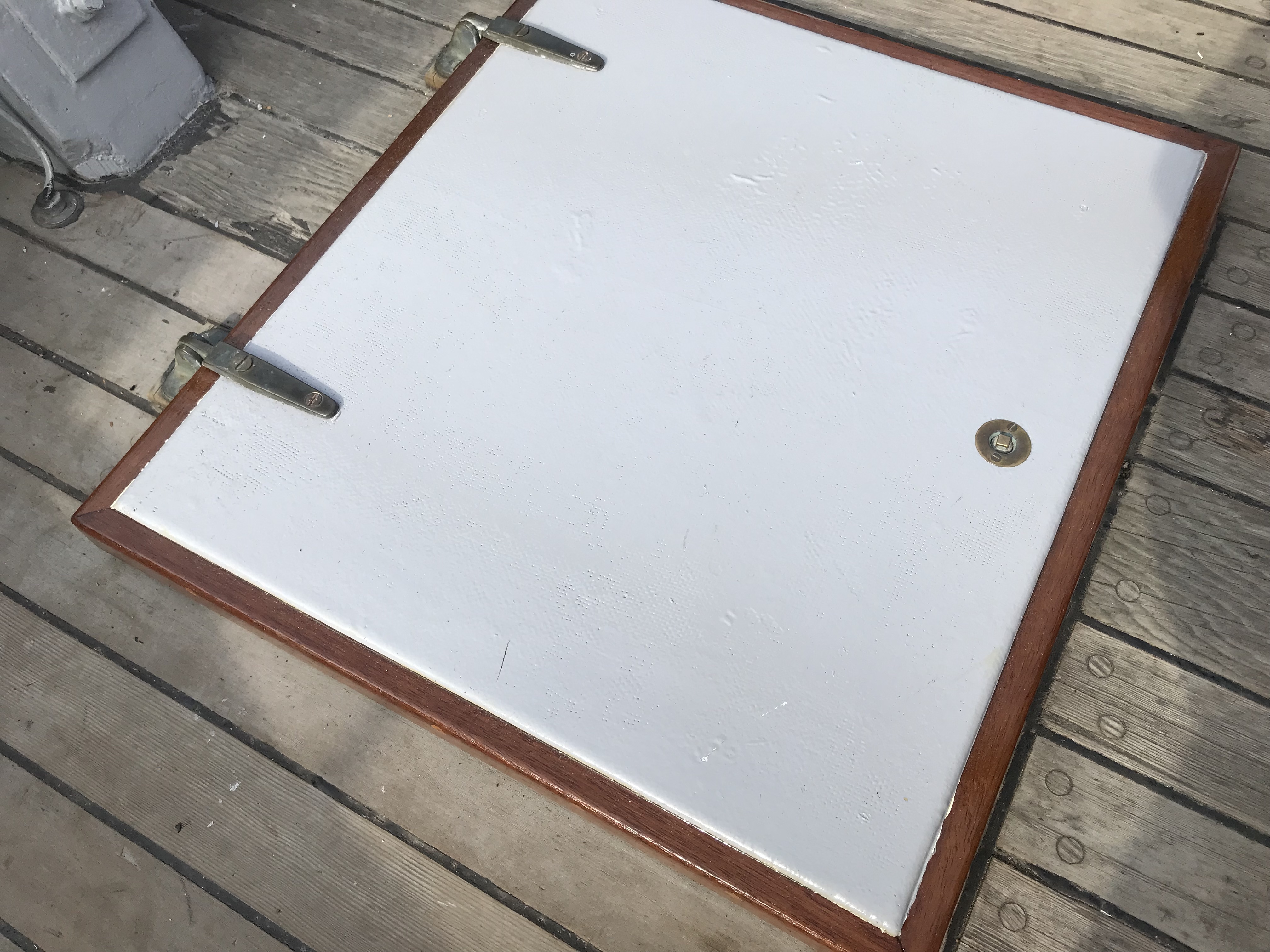
Graham, the professional shipwright who looks after Guiding Star, refurbished the main and lazarette hatches and fitted the main hatch on runners to make it easier to close and lock. He also repaired some stanchions which were showing signs of age.

We relaunched on a Wednesday afternoon high water and set off the next morning for the Looe Lugger Regatta, just in time.

Anchored in Brittany

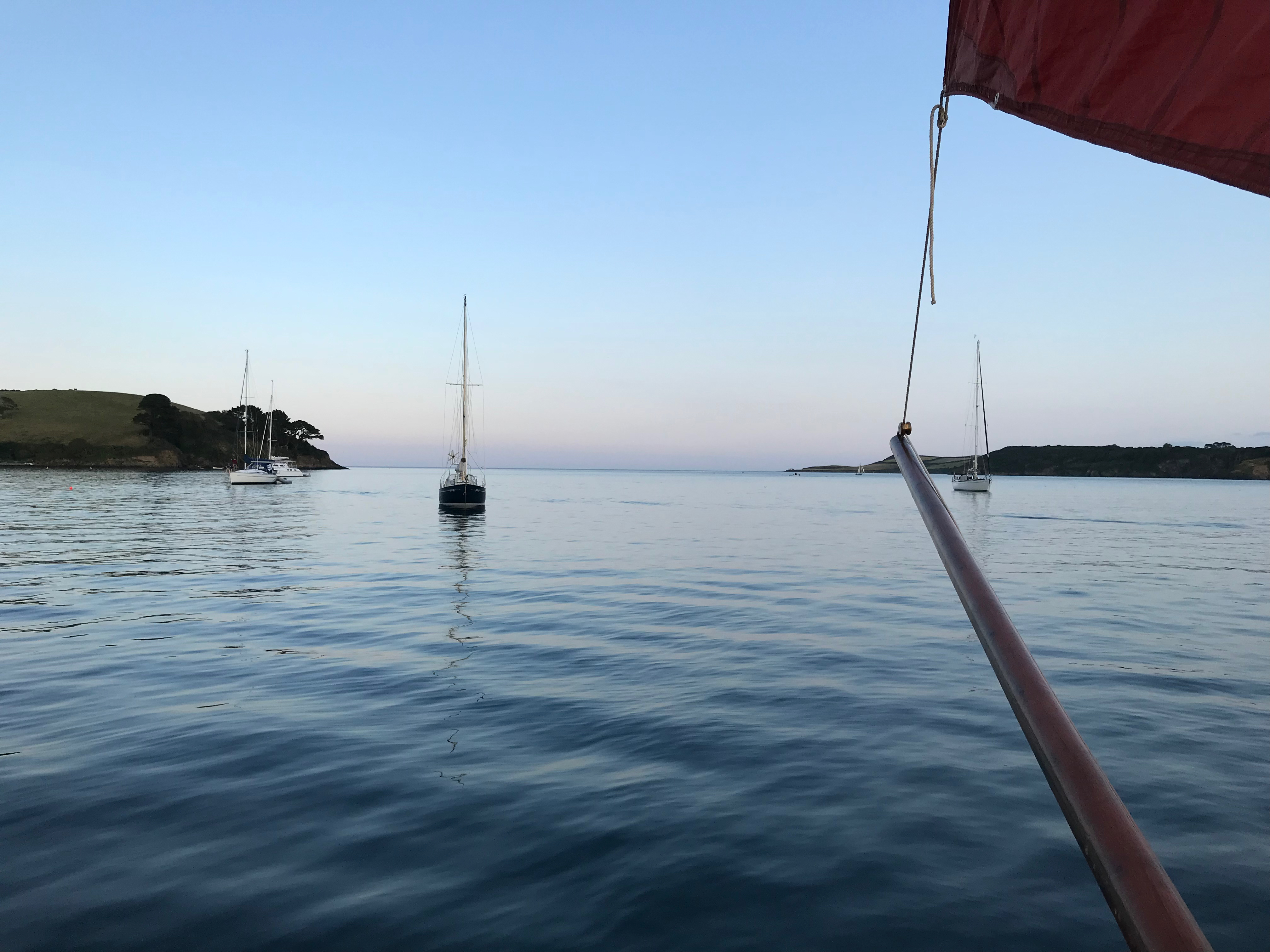
There’s nothing like the peace of anchoring for the night in a quiet bay far from the busyness of a marina or a harbour and watching the sun go down. July in Brittany in a heatwave was the ideal time to explore some new places and leave the restaurant food and the hot showers till another day.

But first, dolphins. A large pod found us while we were still motoring south from Falmouth waiting for enough breeze to put the sails up.

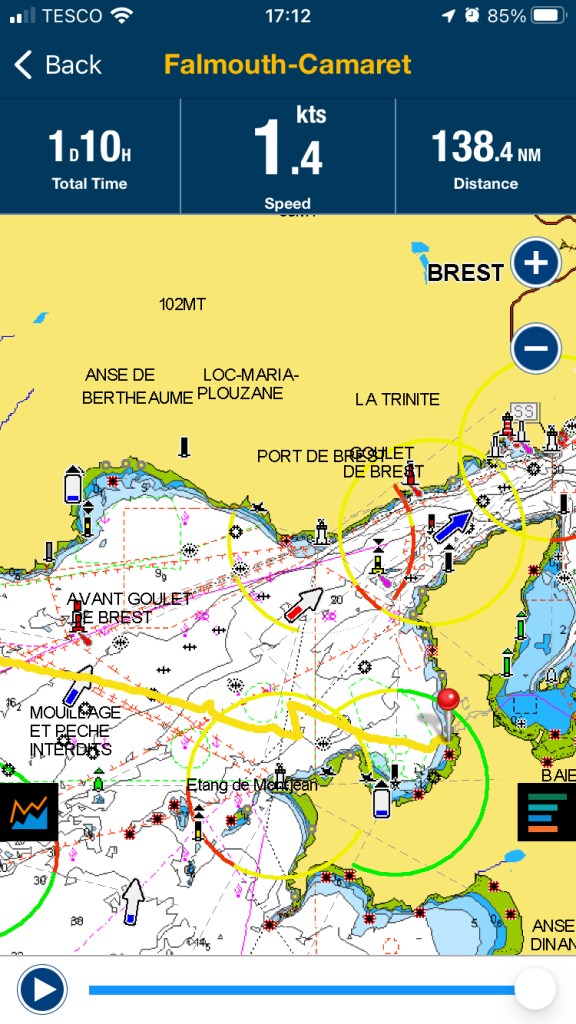
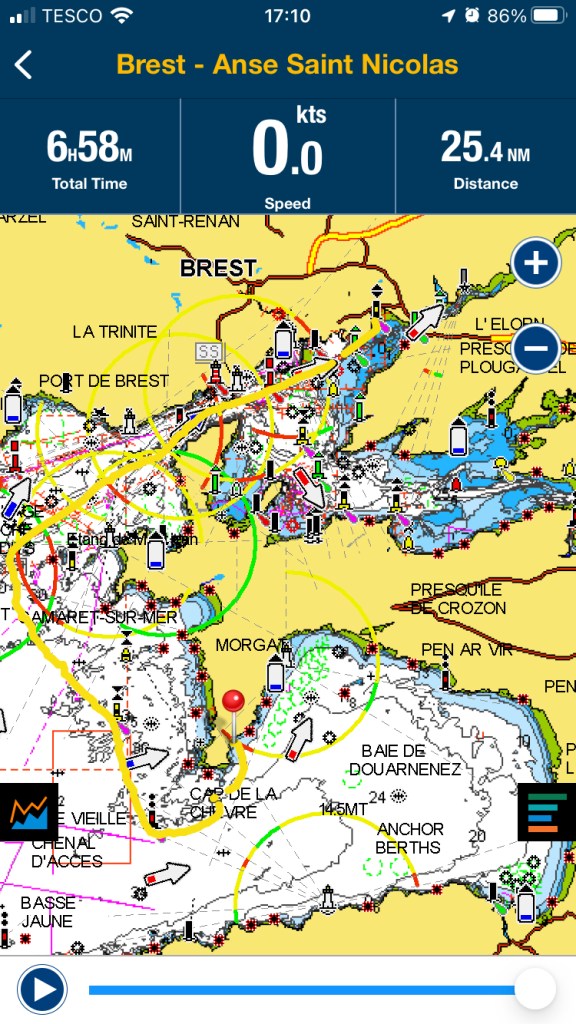
The photo at the top of the page shows our first stop after crossing the Channel from Falmouth. We’d intended to anchor in a bay on the north side of the outer approach to Brest, the Avant Goulet (‘outer throat’). But when we shot out of the bottom of the Chenal du Four, we hit a fresh breeze from the east and changed plan to beat for shelter under the cliffs by Camaret sur Mer. The Anse de Bertheaume on the chart below was our original destination.

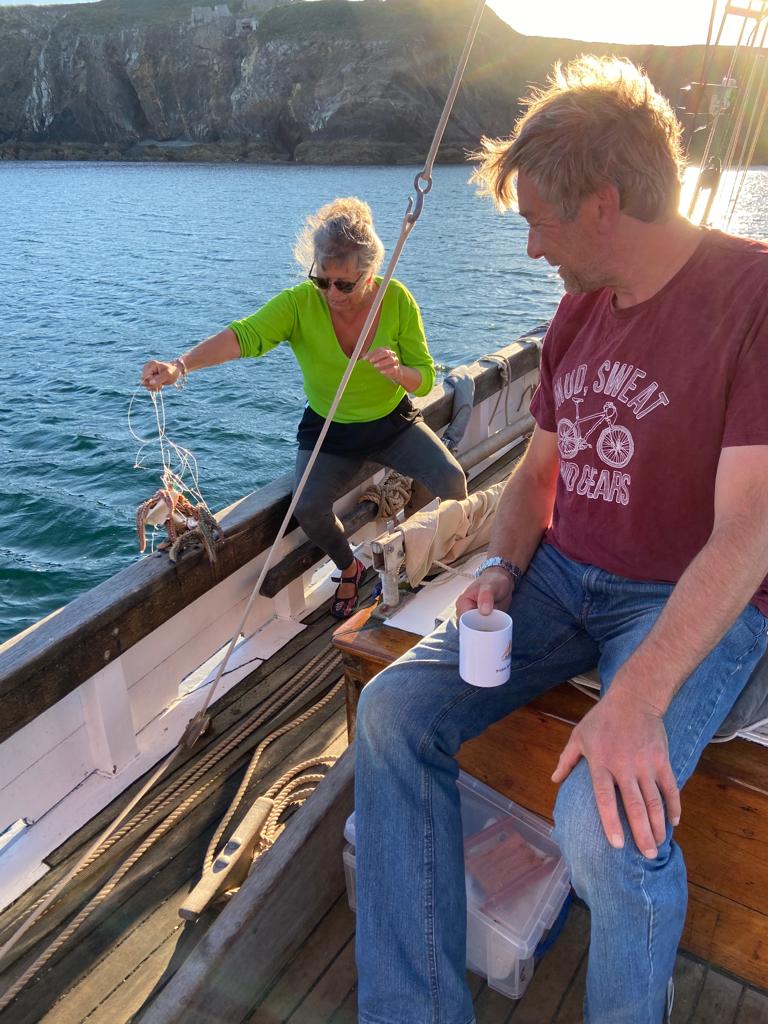
Lois left a fishing line down overnight but caught mostly starfish. A small fish died on her hook and the starfish spent the night scrambling over its caracass.

Then to Brest to have our passports stamped. Not on a Sunday, of course, but we went ashore anyway and demolished several crabs at the Crab and Hammer. It does what it says on the sign.

It’s not much more than 30 miles from Brest to Douarnenez but we were early for the Temps Fete festival so spent a night on the north side of Douarnenez Bay in the beautiful Anse Saint Nicolas.

In Douarnenez (pop. 14,000) for the first time in four years, I found unexpected tensions. A town council for many years run by leftists has been won by right-wingers. Fly posters complain that Douarnenezians are becoming an endangered species because of holiday rentals and the ‘Sardine Walk’ trail of story-boards appears to have been crudely edited. The last story board used to tell how Douarnenez was the ‘Red Town’, one of the first places to elect a Communist council in 1921 and celebrating a history of labour activism in the sardine factories. Now there’s just a patch of fresh asphalt where the story board used to stand. Luckily, someone has posted all the storyboards to Pinterest so here’s No. 17 in three languages.

Heading north again, we finally made it to the Anse de Berthaume. It’s pretty, but protected only from the north and full of mooring buoys.

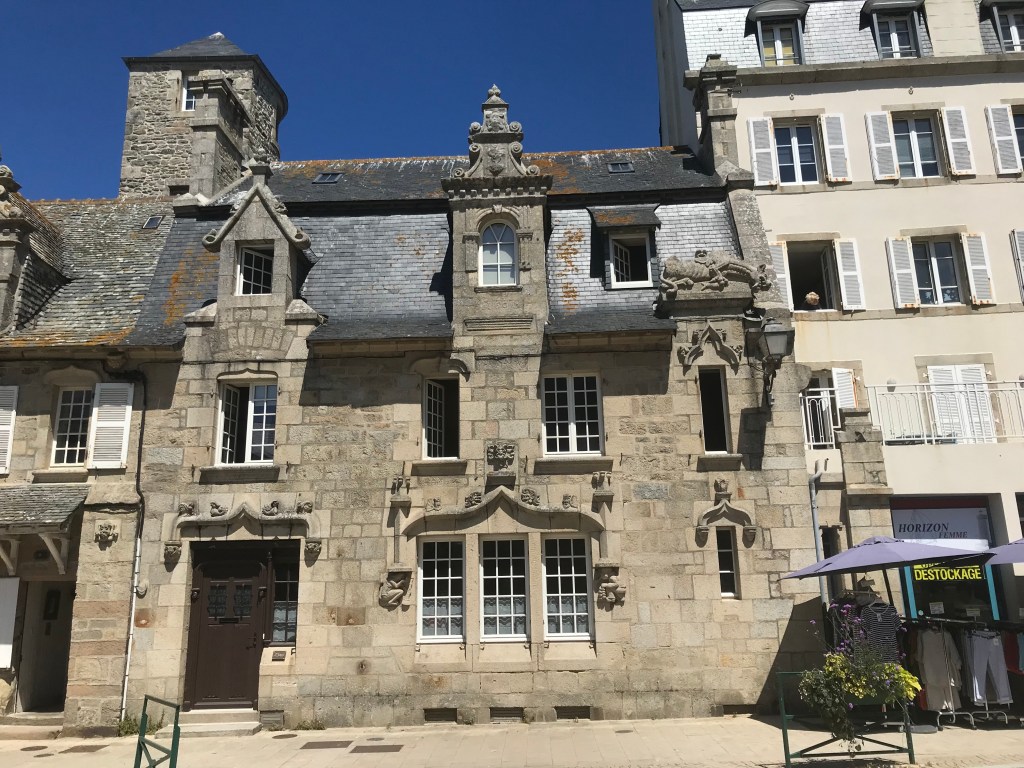
We chose Roscoff on the north coast as the most convenient port to have our passports stamped out, but the town turned out to be a delight: fabulous stone-carved mediaeval merchants’ houses, an ‘Exotic Garden’ of semi-tropical plants, top-quality crepes and a free bus that linked marina, town and supermarket. The modern marina was efficient and we had only a five-minute walk to the ferry terminal to have our passports stamped.

Manoeuvering a 16-tonne traditional boat with offset propeller out of the marina took a multi-point turn and a mile out into the Channel, we realised that all the forwards and backwards action had broken the engine throttle cable off the engine control. It was fortunate this hadn’t happened when we were nudging between expensive boats. We could still operate the engine with Peter’s foot doing the job of the cable, though, so we pressed on across the channel.

Arriving in Plymouth, we anchored in Cawsand Bay and shipwright Graham, who lives in Cawsand, rowed aboard to join in studying the problem. He suggested a long piece of string to pull the throttle lever until we could replace the cable, and with that high-tech solution we berthed smoothly at home in Plymouth Yacht Haven.

France at last!

After three years of pandemic lockdowns and uncertainty over post-Brexit passport arrangements, we finally made it to France! We sailed Guiding Star to northern Brittany, to Binic’s friendly annual festival of boats, food and music celebrating the generations of French fishermen who spent six months a year catching cod in the freezing fog off Newfoundland.

We set sail from Plymouth after breakfast, reached straight across the Channel in a steady breeze and warm sunshine, and anchored off Binic at dawn next day to wait for the nine-metre high tide we needed to cross the sandy beach and enter the harbour.

Brexit has added some friction for British sailors: we used to just sail to and fro across the Channel and nobody bothered with passports or boat documents. This time, once we locked in on the afternoon high tide, we had an hour to hunt down the customs police headquarters before they closed. We borrowed a kind friend’s car, Google-mapped our way to a small industrial estate several miles away (thanks to Chris for continual reminders to drive on the right), and made it in time. An overworked customs officer stamped our passports, for me the first French stamp since I went on a school French exchange in 1971.

We should properly have sailed to St Brieuc, six miles down the coast, because non-EU boats should only make land in northern Brittany in one of three ‘ports of entry’ widely spaced along the coast. But the festival organisers persuaded the police to let us sail direct to Binic.

To stamp out of France after the weekend of fun, we should have gone back to the customs headquarters on Monday during office hours, so missing the dawn high tide to set sail. But in an ‘exceptional procedure’, two officers in plain clothes met us in a car park in Binic on Sunday afternoon and stamped our passports in the back of a white van. I hope in another couple of years, someone will have negotiated a pragmatic deal to allow sailors cross the Channel as easily as we used to and let the customs police to get on with catching smugglers.

Our passage back took nearly twice as long as the trip over, first motoring for 12 hours through a millpond sea, then beating into a fickle northwesterly blowing from exactly where we wanted to go. But we did hoist Guiding Star’s new topsail for the first time, and it set perfectly. We had last season’s new sail, the big genoa, up as well as 2020’s new main and staysail, so this was the first time we’d had all Guiding Star’s four new sails up at the same time.

I then left the sails up for too long when the wind freshened and let the genoa drag over the side when I thought it was safely tied up on deck, but we recovered well. We berthed in Plymouth after 36 hours at sea and just made it to the pub before the kitchen closed. Many thanks to Chris, John and Martin for a terrific trip.

Idyllic Helford

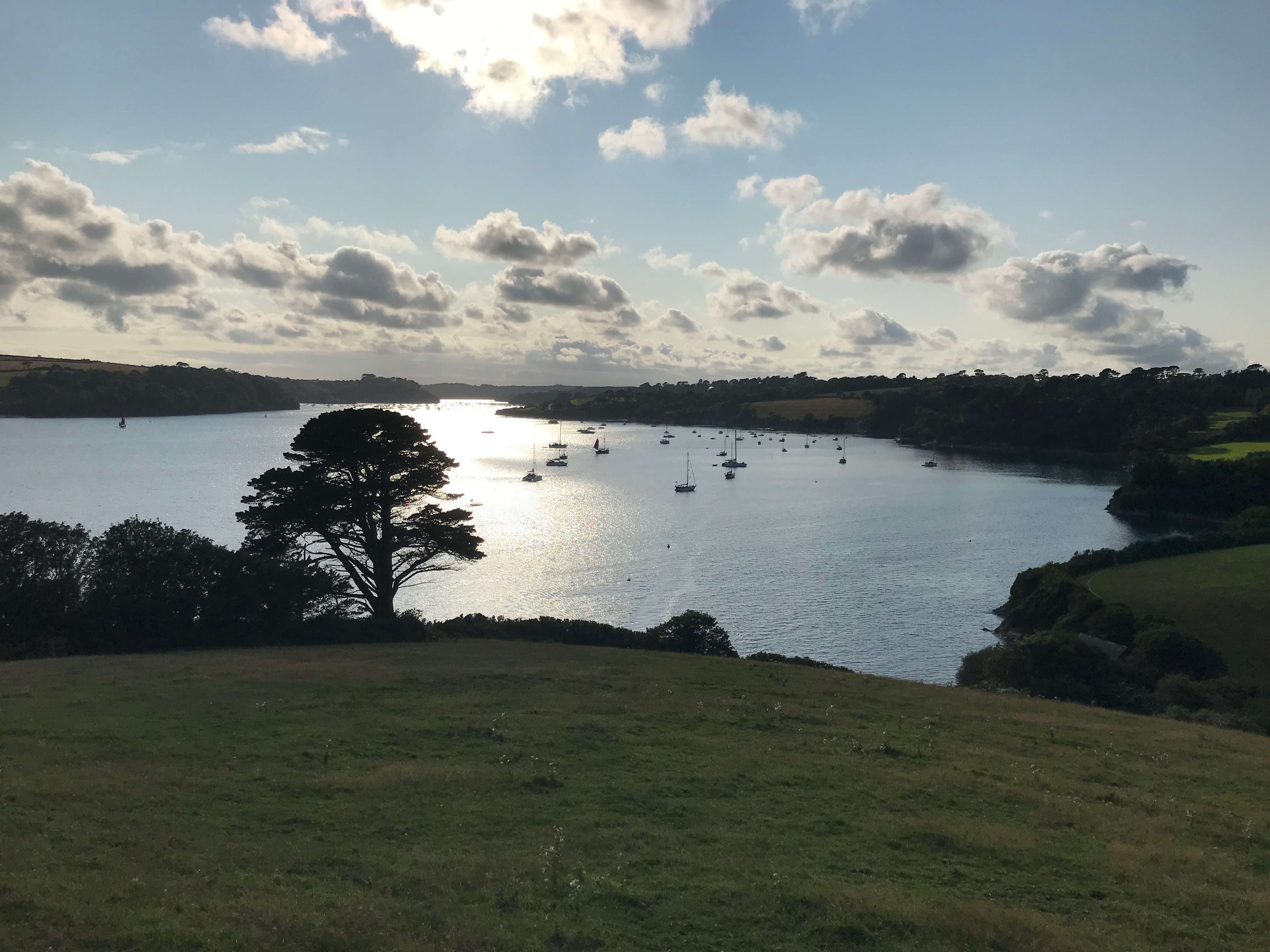
I wanted to go to France for the first time since the pandemic, but after several days of email exchanges to pin down the new post-Brexit arrangements for clearing customs and immigration in Brittany, I gave up. But that brought a chance to sail to one of the most beautiful places on earth, the Helford River.

On the passage down, we dodged low cloud and fog. But then the sun came out; and later, an extraordinary orange moon rose in a cloudless night sky.

Moored in Fowey on the way back to Plymouth, we climbed Polruan Hill and watched the tide flood up the river, each boat swinging as the line of darker blue reached her.

By our home marina in Cattewater, the skilled team on the Island Trust’s schooner Johanna Lucretia manoeuvred her against the wharf in Turnchapel to work on her hull at low tide as we were walking to the pub for a celebratory meal.

The magic of Scilly

I’ve never been anywhere quite like the Isles of Scilly: smaller, lower, and more exposed to the ocean than I had ever imagined. When I was a child, snobbish newspapers used to mock the Prime Minister, Harold Wilson, for spending all his summers on Scilly, as if he lacked imagination or class to travel further. How wrong they were.

St Mary’s
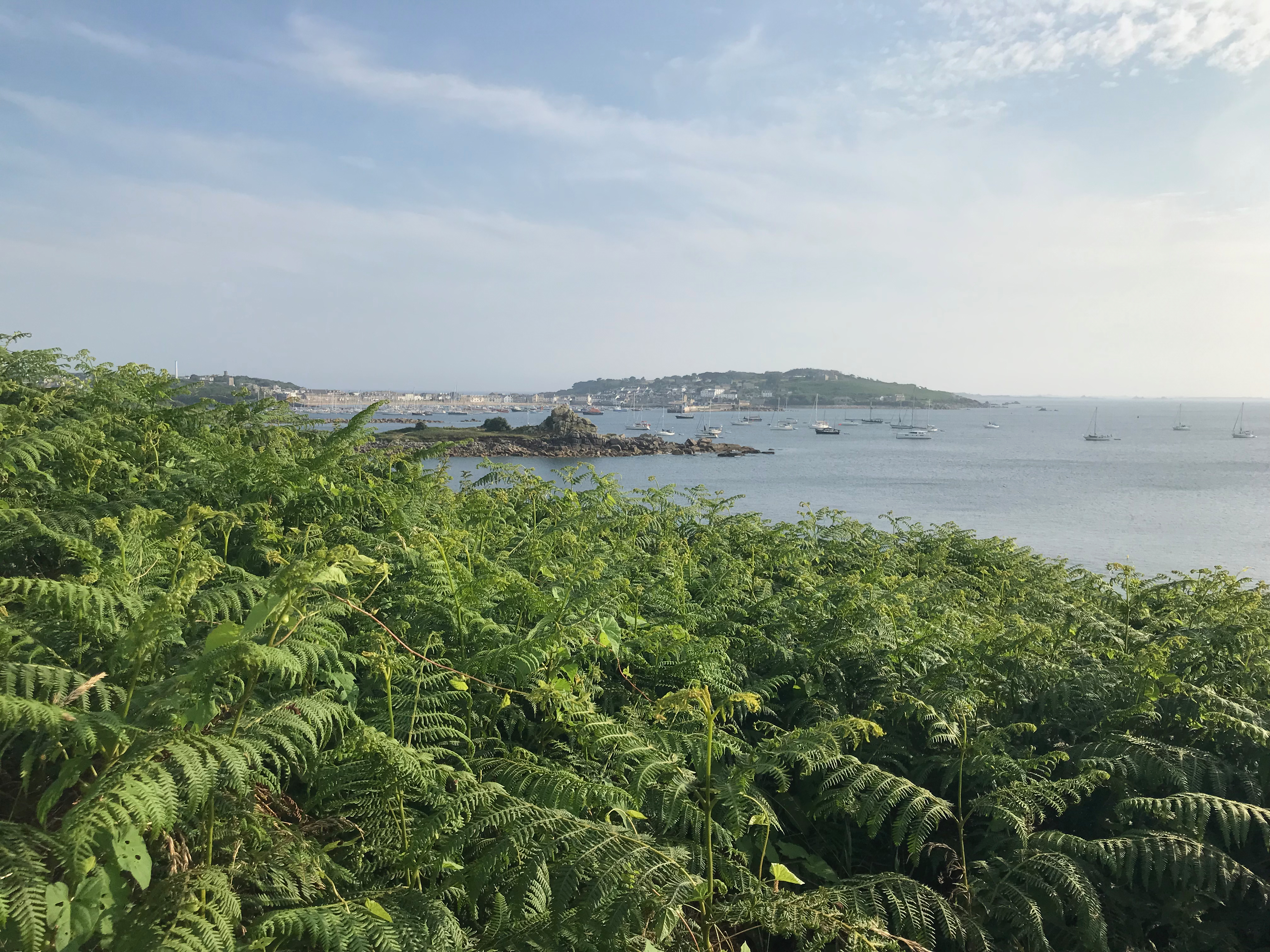
Looking back at the anchorage and Hugh Town
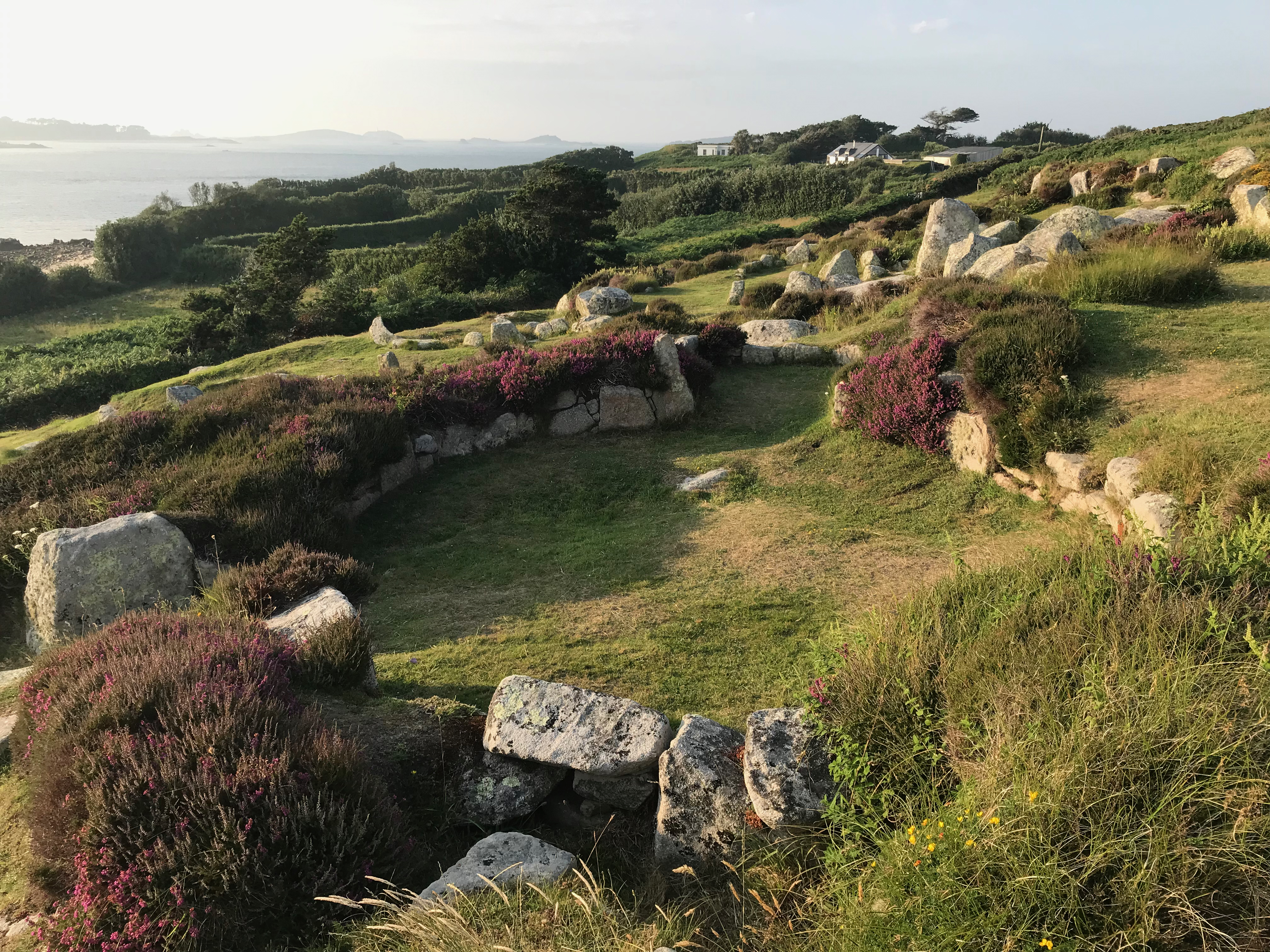
Halangy Ancient Village, where the first stone houses were built in the Iron Age

Sailing to Scilly, we were entranced by a minke whale swimming off the port side of the boat. So entranced that I was slow to get the camera out, but I did record a glimpse.